Oil on canvas
Braque made Homage to J. S. Bach toward the end of a period of several months in which he and Pablo Picasso worked very closely together, producing paintings in a style that has become known as Analytic Cubism. In Analytic Cubism space is very compressed and shallow, colors are reduced to a palette of tans and grays, and identifiable subject matter—here, the parts of a violin—appears only in flickering moments. With this painting Braque introduced imitation wood grain to Cubism. He had learned this technique while working as a housepainter, and the Cubist practice of stenciling letters—here, BACH, J, and S—was also inspired by Braque's commercial training. Picasso and Braque employed multiple modes of representation simultaneously: in this work, Braque combined virtuoso illusionistic wood grain with linguistic references and near abstraction.
Braque was trained as a classical musician, and he thought musical instruments added a tactile dimension to the visual image: "The distinctive feature of the musical instrument as an object," he said, "is that it comes alive to the touch." Johann Sebastian Bach, whose polyphonic compositions may be seen as musical analogues to the shifting planes and multiple perspectives of Analytic Cubism, was one of Braque's favorite composers. Rare for his work of this period, Braque signed his name prominently on the paintings face, perhaps to invite the slippage of sound between the composers name and his own.
2007.
Gallery label from 2011.
In the lower-left corner of this painting, Braque introduced imitation wood grain to Cubism. He had learned this technique while working as a housepainter; the Cubist practice of stenciling letters—here, BACH, J, and S—was also inspired by Braque’s commercial background. Braque was a trained classical musician, and Johann Sebastian Bach, whose polyphonic compositions are musical analogues to the shifting planes and multiple perspectives of Analytic Cubism, was one of his favorite composers. Rare for his work of this period, Braque signed his name prominently on the painting’s face, perhaps to invite a slippage of sound between the composer’s name and his own.
2011.
Explore more
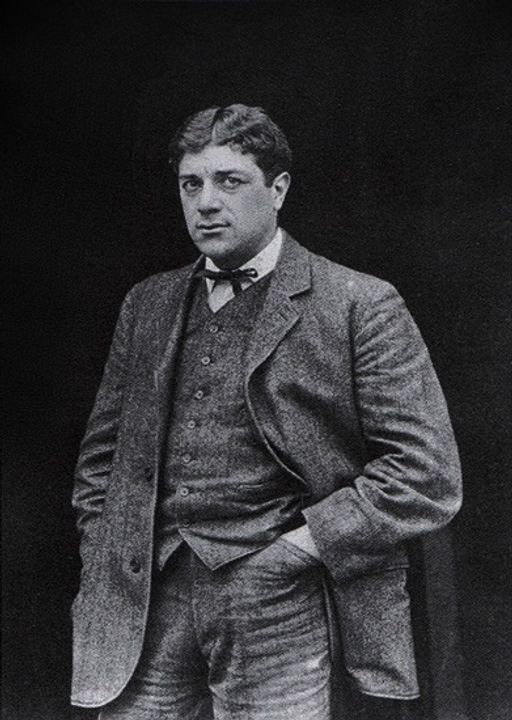
Georges Braque
French, 1882–1963 68 works onlineGuitars, violins, clarinets, mandolins. These are some of the musical instruments that appear in the paintings , drawings , and prints by artist Georges Braque, best known for his role in inventing Cubism with Pablo Picasso in the early 20th century.
Learn more →
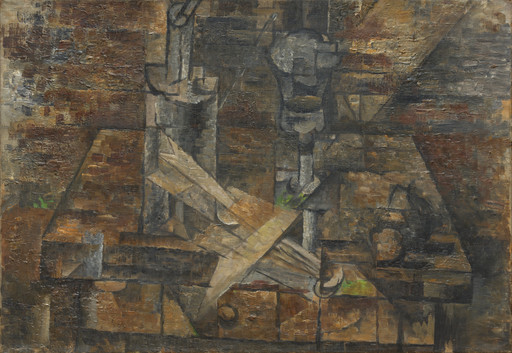
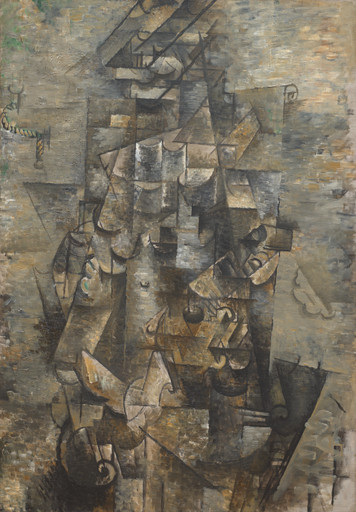
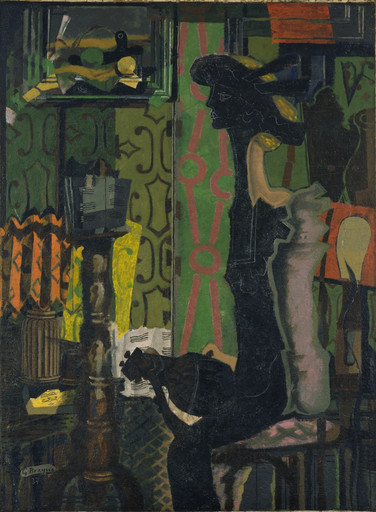
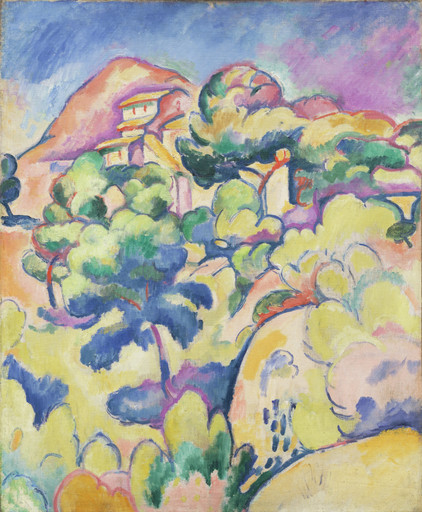
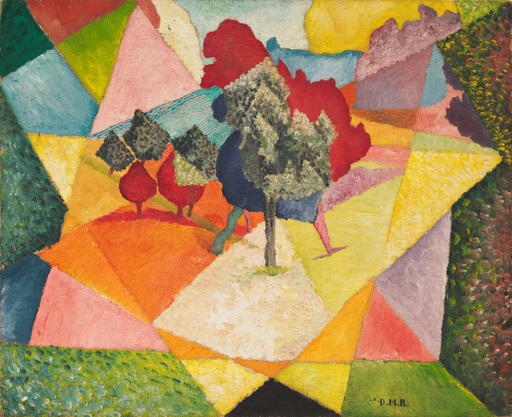
A Cubist Salon
Gallery 503What does Cubism look like? For the international network of artists who first engaged with this movement, it was a work in progress.
Learn more →


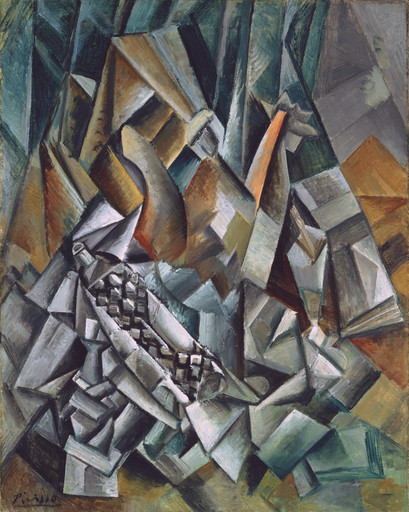
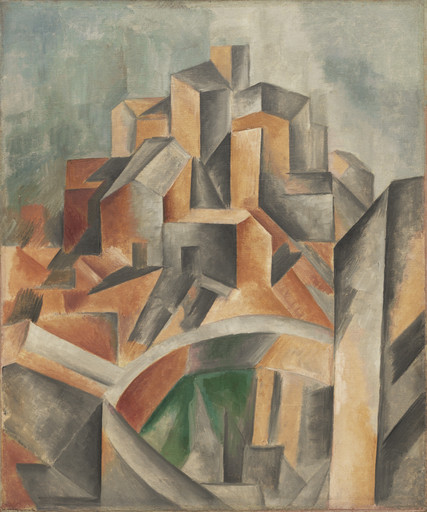

From MoMA Design Store


Installation views
We have identified this work in the following photos from our exhibition history.
Provenance Research Project
This work is included in the Provenance Research Project, which investigates the ownership history of works in MoMA's collection.
Summer 1912 - December 12, 1914, Galerie Kahnweiler (photo no. 1045), Paris, purchased from the artist.
December 12, 1914 - May 7-8, 1923, Kahnweiler collection and gallery stock, sequestered during World War I by the French government as enemy property and sold through Hôtel Drouot to unidentified buyer (4th sale of Kahnweiler collection, May 7-8, 1923, lot 129), Paris.
C. 1927, Pierre and Dollie Chareau's apartment, Paris.
[C. 1927, Jean and Annie Dalsace, Paris c/o Pierre and Dollie Chareau, Paris]
June 27, 1930 - 1959, Henri-Pierre and Denise Roché (1879-1959), Paris, purchased from "a friend".
1959 - ?, Estate of Henri-Pierre Roché, Paris.
[Norman Granz]
[Nicole Higgons, Paris]
1968, Sidney and Harriet Janis, New York, purchased at auction (Impressionist and Modern Paintings, Drawings and Sculpture, Sotheby's, London, April 24, 1968, lot no. 134).
1989 - 2008, Private Collection, New York.
2008, The Museum of Modern Art, New York, acquired as gift and purchased from private collection, New York.
Provenance research is a work in progress, and is frequently updated with new information. If you have any questions or information to provide about the listed works, please email [email protected] or write to:
Provenance Research Project
The Museum of Modern Art
11 West 53 Street
New York, NY 10019
Licensing
Artwork or archival images
If you would like to reproduce an image of a work of art in MoMA's collection, or an image of a MoMA publication or archival material (including installation views, checklists, and press releases), please contact Art Resource (publication in North America) or Scala Archives (publication in all other geographic locations).
Audio and film clips
MoMA licenses archival audio and select out of copyright film clips from our film collection. At this time, MoMA produced video cannot be licensed by MoMA/Scala. All requests to license archival audio or out of copyright film clips should be addressed to Scala Archives at [email protected]. Motion picture film stills cannot be licensed by MoMA/Scala. For access to motion picture film stills for research purposes, please contact the Film Study Center at [email protected]. For more information about film loans and our Circulating Film and Video Library, please visit Circulating Film and Video Library.
Text from a publication or the archives
If you would like to reproduce text from a MoMA publication, please email [email protected]. If you would like to publish text from MoMA's archival materials, please fill out this permission form and send to [email protected].
Feedback
This record is a work in progress. If you have additional information or spotted an error, please fill out this feedback form.