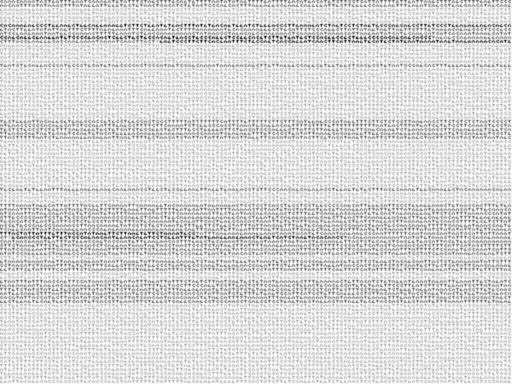
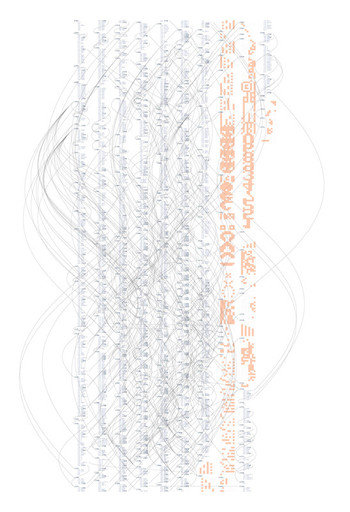
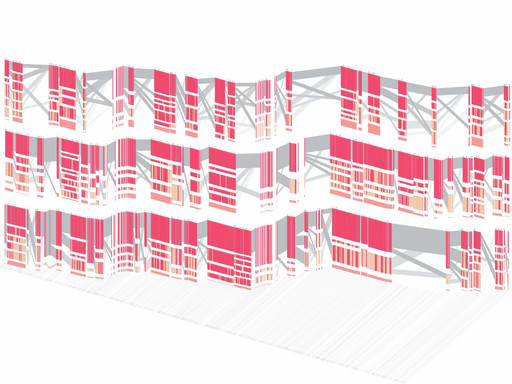
To deliver messages clearly and effectively, information designers often rely on formal elegance to attract attention and command respect for the subject matter in question. In 2003, Viégas and Wattenberg, leading figures in contemporary visualization design, set out to investigate the dynamics behind the editing histories of Wikipedia pages. The colorful diagrams transform lengthy editing sagas into images. In this example, the pink graph shows the edit history for the entry “chocolate,” while the green one shows the edits behind “abortion.” Zigzag patterns represent back-and-forth edits, often disagreements between editors. Black gashes show points where the represented article was deleted and replaced with comments―a virtual act of vandalism.
Pirouette: Turning Points in Design, January 26, 2025–November 15, 2025
Explore more
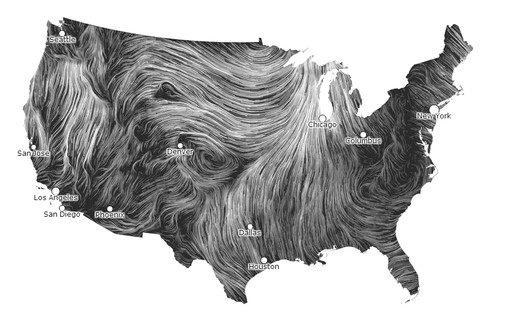
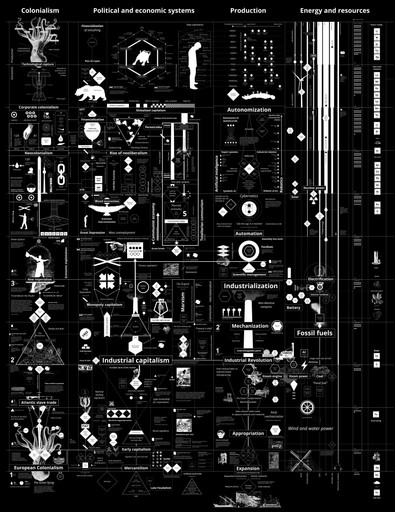
The Edge of Information Design
1 SouthWe swim in an ocean of data. Every click, weather pattern, border crossing, and blood test is tracked and fed into systems that increasingly inform our daily behaviors. Data, however, is not knowledge.
Learn more →

From MoMA Design Store


Installation views
We have identified this work in the following photos from our exhibition history.
Licensing
Artwork or archival images
If you would like to reproduce an image of a work of art in MoMA's collection, or an image of a MoMA publication or archival material (including installation views, checklists, and press releases), please contact Art Resource (publication in North America) or Scala Archives (publication in all other geographic locations).
Audio and film clips
MoMA licenses archival audio and select out of copyright film clips from our film collection. At this time, MoMA produced video cannot be licensed by MoMA/Scala. All requests to license archival audio or out of copyright film clips should be addressed to Scala Archives at [email protected]. Motion picture film stills cannot be licensed by MoMA/Scala. For access to motion picture film stills for research purposes, please contact the Film Study Center at [email protected]. For more information about film loans and our Circulating Film and Video Library, please visit Circulating Film and Video Library.
Text from a publication or the archives
If you would like to reproduce text from a MoMA publication, please email [email protected]. If you would like to publish text from MoMA's archival materials, please fill out this permission form and send to [email protected].
Feedback
This record is a work in progress. If you have additional information or spotted an error, please fill out this feedback form.