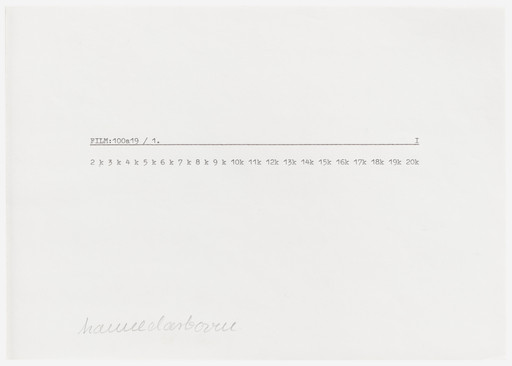
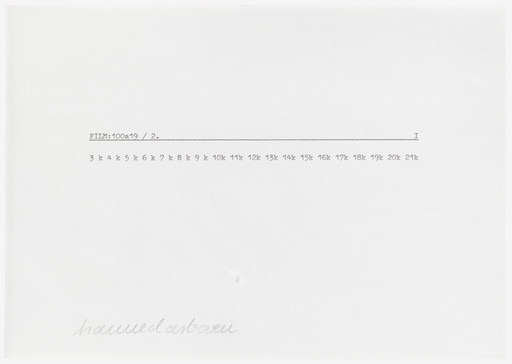
Darboven was at the forefront of Conceptual art from its beginnings in the late 1960s until her death. Evincing a strict sense of order and an obsessive discipline, her work uses numerical systems to explore time and the documentation of her life—a mode of working she likened to "a way of writing without describing." While living in New York City from 1966 to 1968, Darboven developed her characteristic painstakingly choreographed lines, producing the rhythmic cadence visible in this untitled work made around 1972.
Darboven worked in near-isolation during her time in New York but did befriend the artist Sol LeWitt, whose work shares an intellectual and formal relationship with her own. Both artists created systematic, iterative visual styles, thereby "[freeing] art from both representation and expressive emotion," LeWitt noted. LeWitt was "struck by the originality and depth of [Darboven's] work," which he believed helped free art from representation, emphasizing ideas over aesthetics. Her emphasis on process and duration makes time both the raw material and the subject of her art. Like a journal or a diary, her work reflects her life, but her use of mathematical principles keeps her personal history private.
Sites of Reason: A Selection of Recent Acquisitions, June 11–September 28, 2014.
Explore more



From MoMA Design Store


Installation views
We have identified this work in the following photos from our exhibition history.
Licensing
Artwork or archival images
If you would like to reproduce an image of a work of art in MoMA's collection, or an image of a MoMA publication or archival material (including installation views, checklists, and press releases), please contact Art Resource (publication in North America) or Scala Archives (publication in all other geographic locations).
Audio and film clips
MoMA licenses archival audio and select out of copyright film clips from our film collection. At this time, MoMA produced video cannot be licensed by MoMA/Scala. All requests to license archival audio or out of copyright film clips should be addressed to Scala Archives at [email protected]. Motion picture film stills cannot be licensed by MoMA/Scala. For access to motion picture film stills for research purposes, please contact the Film Study Center at [email protected]. For more information about film loans and our Circulating Film and Video Library, please visit Circulating Film and Video Library.
Text from a publication or the archives
If you would like to reproduce text from a MoMA publication, please email [email protected]. If you would like to publish text from MoMA's archival materials, please fill out this permission form and send to [email protected].
Feedback
This record is a work in progress. If you have additional information or spotted an error, please fill out this feedback form.