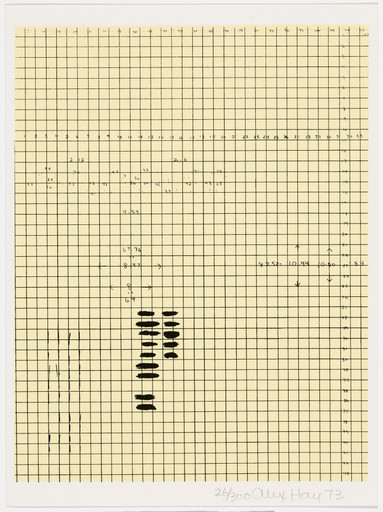
To create Ground Drawing the artist saturated a piece of cotton cellulose paper with liquid then allowed it to dry over a patch of ground in Venice, California, transferring the earth’s bumps and irregularities to its surface. He then painstakingly traced each indentation with a pencil and indicated the precise degree of each incline, creating a complex pattern of lines and angles. The random means deployed to generate this drawing—a kind of map of the earth’s surface—are similar to those he used in the dance and movement-based works he performed with New York’s Judson Dance Theater from 1962 to 1964.
On Line: Drawing Through the Twentieth Century, November 21, 2010-February 7, 2011.
Gallery label from 2007.
A cofounder of the Judson Dance Theater in 1962, Hay was heavily involved in emerging performance art and avant-garde dance in the 1960s, and these interests carried over to his work in more traditional media. To create Ground Drawing the artist saturated a piece of cotton cellulose paper with liquid, then allowed it to dry over a patch of ground in Venice,California, transferring the earth's bumps and irregularities to its surface. He then painstakingly traced each indentation, visually emphasizing the earth's physical unevenness and indicating the precise degree of each bump's incline. Hay's intense focus on an anonymous patch of ground draws our attention to the intricacies of the easily overlooked and ephemeral.
2007.
Explore more

From MoMA Design Store


Installation views
We have identified this work in the following photos from our exhibition history.
Licensing
Artwork or archival images
If you would like to reproduce an image of a work of art in MoMA's collection, or an image of a MoMA publication or archival material (including installation views, checklists, and press releases), please contact Art Resource (publication in North America) or Scala Archives (publication in all other geographic locations).
Audio and film clips
MoMA licenses archival audio and select out of copyright film clips from our film collection. At this time, MoMA produced video cannot be licensed by MoMA/Scala. All requests to license archival audio or out of copyright film clips should be addressed to Scala Archives at [email protected]. Motion picture film stills cannot be licensed by MoMA/Scala. For access to motion picture film stills for research purposes, please contact the Film Study Center at [email protected]. For more information about film loans and our Circulating Film and Video Library, please visit Circulating Film and Video Library.
Text from a publication or the archives
If you would like to reproduce text from a MoMA publication, please email [email protected]. If you would like to publish text from MoMA's archival materials, please fill out this permission form and send to [email protected].
Feedback
This record is a work in progress. If you have additional information or spotted an error, please fill out this feedback form.