Rem Koolhaas, Madelon Vriesendorp
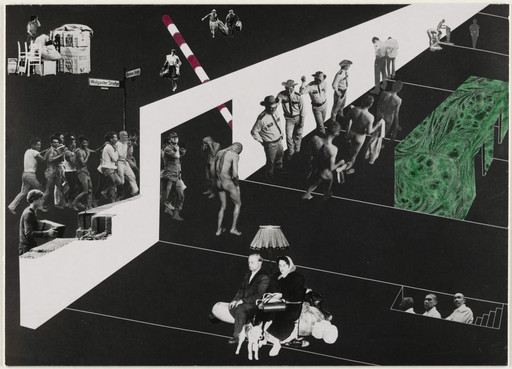
The City of the Captive Globe Project, New York, New York, Axonometric
1972
Gouache and graphite on paper
Not on view
The City of the Captive Globe is a rendering of Rem Koolhaas's intuitive approximation of the architecture of Manhattan. This drawing, according to the architect, celebrates Manhattan's "culture of congestion," presenting a relentless grid as Manhattan's overriding characteristic. Within this scheme, each city block is designated to embody a different value or philosophy, among these are many avant-garde movements previously thought of as incompatible. Each block, which is itself a city, is surmounted by a structure that represents its function or identity, for example, El Lissitzky's Lenin's Stand, Le Corbusier's Plan Voisin, or Wallace Harrison's Trylon and Perisphere for the 1939 New York World's Fair. Koolhaas's metaphor proposes an urban model in which unity accommodates heterogeneity.
an essay by Bevin Cline and Tina di Carlo, in Terence Riley, ed., The Changing of the Avant-Garde: Visionary Architectural Drawings from the Howard Gilman Collection, New York: The Museum of Modern Art, 2002, p. 122.
Publication excerpt from an essay by Terence Riley, in Matilda McQuaid, ed., Envisioning Architecture: Drawings from The Museum of Modern Art , New York: The Museum of Modern Art, 2002, p. 172.
In honoring Manhattan's "culture of congestion," Rem Koolhaas's 1978 book Delirious New York found inspiration where Le Corbusier had seen chaos. Several projects developed by Koolhaas and his colleagues in the Office for Metropolitan Architecture (O.M.A.) appeared in the book; those presented here were also included in the 1978 exhibition The Sparkling Metropolis, at the Solomon R. Guggenheim Museum, New York.
The City of the Captive Globe Project, which Koolhaas produced with Zoe Zenghelis, focuses on New York's urban fabric: the relentlessly uniform grid that paradoxically supports a multiplicity of functions and desires. The rendering of each block as a fantastic city-within-a-city creates a virtual catalogue of OMA's self-proclaimed influences: Salvador Dali's Surreal Archeological Reminiscence of Millet's Angelus (1933–35), Le Corbusier's Plan Voisin towers, and El Lissitzky's Lenin Stand all frame the captured globe, a metaphor for Manhattan's status as an "enormous incubator of the world."
an essay by Terence Riley, in Matilda McQuaid, ed., Envisioning Architecture: Drawings from The Museum of Modern Art, New York: The Museum of Modern Art, 2002, p. 172.
Explore more

From MoMA Design Store


Installation views
We have identified this work in the following photos from our exhibition history.
Licensing
Artwork or archival images
If you would like to reproduce an image of a work of art in MoMA's collection, or an image of a MoMA publication or archival material (including installation views, checklists, and press releases), please contact Art Resource (publication in North America) or Scala Archives (publication in all other geographic locations).
Audio and film clips
MoMA licenses archival audio and select out of copyright film clips from our film collection. At this time, MoMA produced video cannot be licensed by MoMA/Scala. All requests to license archival audio or out of copyright film clips should be addressed to Scala Archives at [email protected]. Motion picture film stills cannot be licensed by MoMA/Scala. For access to motion picture film stills for research purposes, please contact the Film Study Center at [email protected]. For more information about film loans and our Circulating Film and Video Library, please visit Circulating Film and Video Library.
Text from a publication or the archives
If you would like to reproduce text from a MoMA publication, please email [email protected]. If you would like to publish text from MoMA's archival materials, please fill out this permission form and send to [email protected].
Feedback
This record is a work in progress. If you have additional information or spotted an error, please fill out this feedback form.