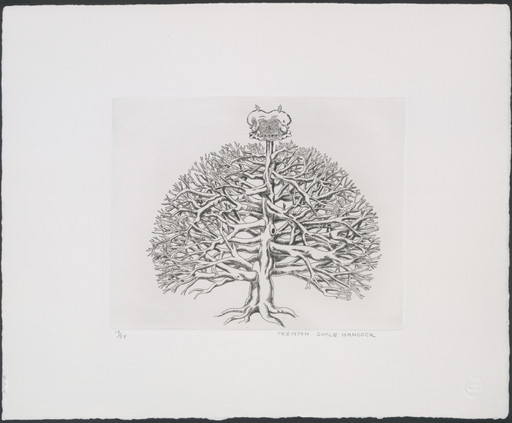
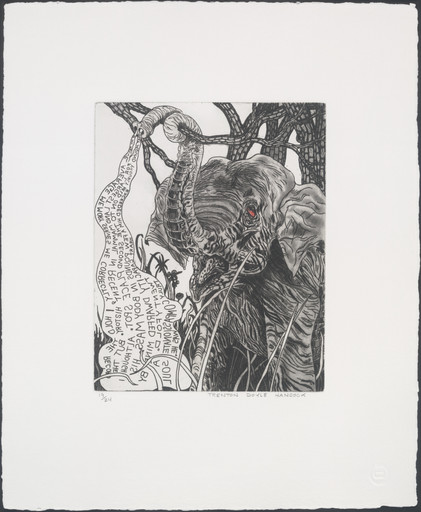
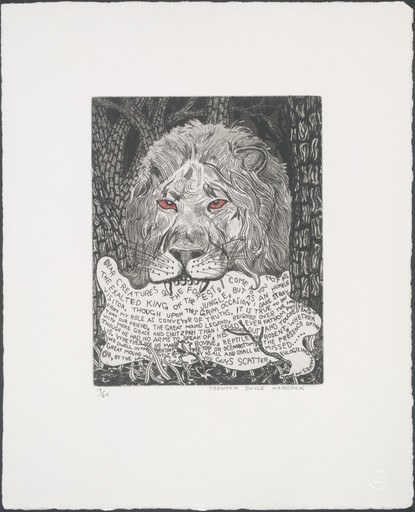
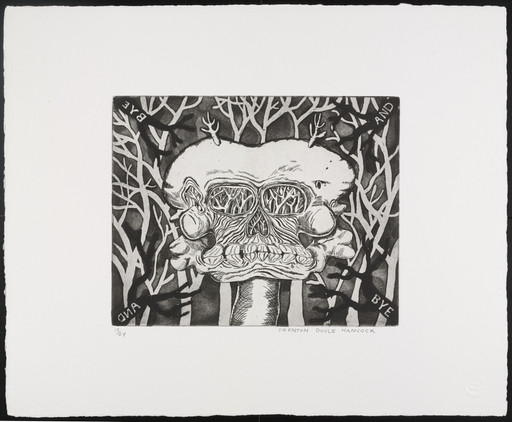
One from a portfolio of eight etching and aquatints
Not on view
Hancock's work examines dualities of light and dark, or good and evil, through a surreal narrative tracing the activities of two opposing groups, the Mounds and the Vegans. Here Sesom, a Vegan, has a dream that shows him how to bring color into the Vegans' black and white world.
Wunderkammer: A Century of Curiosities, July 30–November 10, 2008.
Publication excerpt from The Museum of Modern Art, MoMA Highlights since 1980 , New York: The Museum of Modern Art, 2007, p. 264.
This bizarre, minutely detailed etching comes from the most recent chapter in the strange, epic narrative that Hancock, an artist based in Houston, Texas, has been developing since childhood. Filtering in sources ranging from comic books to the Bible (his stepfather was a Baptist minister) to the satirical work of artists James Ensor and Philip Guston, Hancock's paintings, drawings, and prints depict an alternate, visionary universe populated by hybrid creatures, such as the skeletal "Vegan" seen here, at left.
This etching is from a portfolio that concerns the character Sesom (Moses spelled backwards), described by Hancock as a "freethinking Vegan minister," who lives with his fellow Vegans in a stark subterranean world. In Hancock’s narrative the Vegans have lost the ability to see color from "many years of inbreeding." But Sesom has a dream in which he discovers color’s liberating power, and as a result he begins making miracle machines that generate life-affirming color blasts, represented here by the rainbowlike spectrum emanating from the construction of bones to the right. It is Sesom’s mission to lead his people away from their isolated, monochromatic world to one filled with color, energy, and, ultimately, enlightenment. All of this parallels the reintroduction in Hancock’s own work of vivid, psychedelic color (he had previously limited his palette to black, white, and Pepto-Bismol pink).
The Museum of Modern Art, MoMA Highlights since 1980, New York: The Museum of Modern Art, 2007, p. 264.
Explore more
From MoMA Design Store


Installation views
We have identified this work in the following photos from our exhibition history.
Licensing
Artwork or archival images
If you would like to reproduce an image of a work of art in MoMA's collection, or an image of a MoMA publication or archival material (including installation views, checklists, and press releases), please contact Art Resource (publication in North America) or Scala Archives (publication in all other geographic locations).
Audio and film clips
MoMA licenses archival audio and select out of copyright film clips from our film collection. At this time, MoMA produced video cannot be licensed by MoMA/Scala. All requests to license archival audio or out of copyright film clips should be addressed to Scala Archives at [email protected]. Motion picture film stills cannot be licensed by MoMA/Scala. For access to motion picture film stills for research purposes, please contact the Film Study Center at [email protected]. For more information about film loans and our Circulating Film and Video Library, please visit Circulating Film and Video Library.
Text from a publication or the archives
If you would like to reproduce text from a MoMA publication, please email [email protected]. If you would like to publish text from MoMA's archival materials, please fill out this permission form and send to [email protected].
Feedback
This record is a work in progress. If you have additional information or spotted an error, please fill out this feedback form.