Virtual Cinema screenings are available exclusively to MoMA members. Not a member? Join today and start streaming.
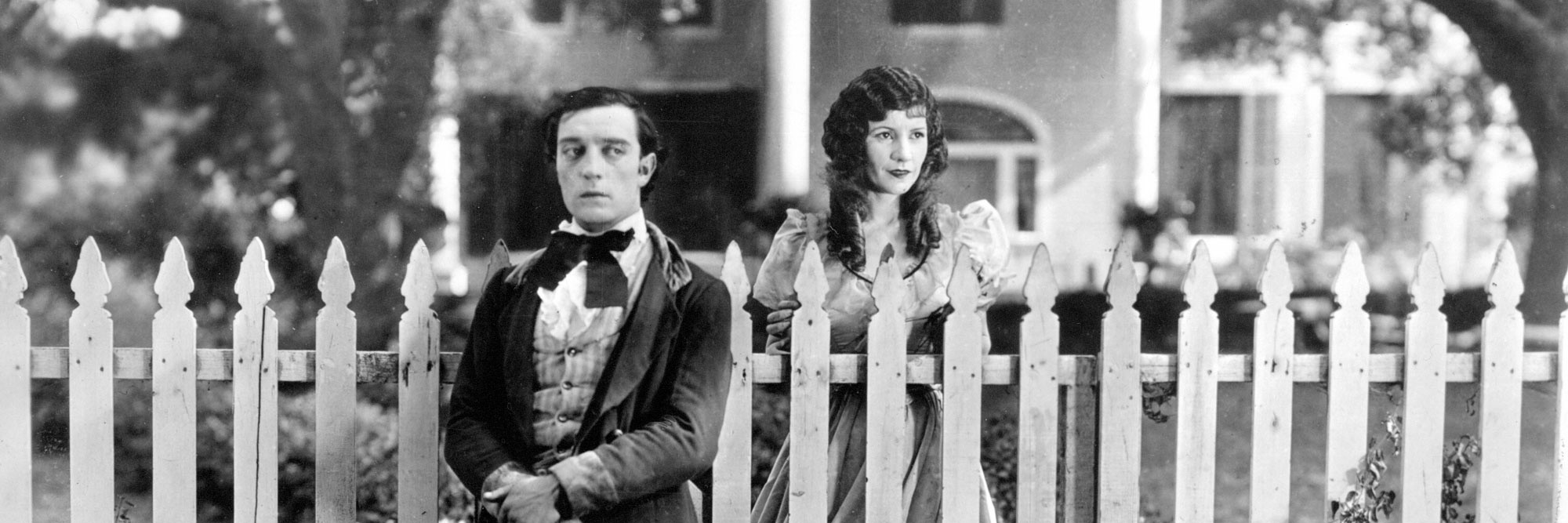
Released in 1923, Our Hospitality was Buster Keaton’s second feature-length film, but the first (after the episodically constructed Three Ages) to fully develop the possibilities of an extended narrative. Where his two-reel shorts could string together improbable and often physically impossible gags into a surreal, stream-of-unconsciousness structure, the extended running time of a five- or six-reel feature meant that gags had to be grounded in character and situation in order to sustain the audience’s interest and belief. The situation that Keaton and his gagmen (Jean C. Havez, Clyde Bruckman, and Joseph A. Mitchell) settled on was the well-worn legend of the Hatfield-McCoy feud, a family rivalry fueled by the Civil War. Keaton moves the conflict back to the 1830s, placing his conflict in a nascent United States just being bound together by the primitive railroad that Keaton mines so memorably for comedy.
Traveling south by train from rural New York City, Keaton’s Willie McKay falls under the spell of a fellow passenger, Virginia Canfield (Natalie Talmadge, Keaton’s then-wife), only to find when he reaches his southern homestead that his new friend’s relations are gunning for him. Beginning in a casual, observational mode, the film, under the direction of Keaton and John G. Blystone, gradually accumulates mass and velocity as it builds to a spectacular climax.
This is a new restoration from Lobster Films, based in part on an original print in MoMA’s collection. New orchestral score by Robert Israel. Special thanks to Serge Bromberg and the Lobster team.
Organized by Dave Kehr, Curator, Department of Film.
Film at MoMA is made possible by CHANEL.
Additional support is provided by the Annual Film Fund. Leadership support for the Annual Film Fund is provided by Debra and Leon D. Black, with major contributions from The Contemporary Arts Council of The Museum of Modern Art, Jo Carole and Ronald S. Lauder, the Association of Independent Commercial Producers (AICP), The Junior Associates of The Museum of Modern Art, and Karen and Gary Winnick.