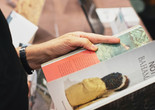
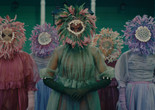
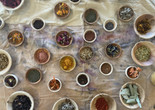
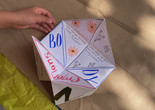
Creativity Lab: Making Space for Belonging offers a hub for visitors, artists, and communities to share ideas, have new encounters, and develop solidarities that embrace notions of kinship, belonging, and collective imagination. Over the course of the project, artistic partners will activate the space through a range of programming and a curated resource library focused on three themes related to belonging: through the mind and body, space and community, and ecologies and environments. Inspired by the exhibition Otobong Nkanga: Cadence, in the Donald and Catherine Marron Family Atrium, this project aspires to question how art helps us understand ourselves through shared histories and our relationships with our own body, community, and the natural world around us.
The Crown Creativity Lab is a participatory space activated by local partner organizations, artists, and MoMA visitors. Each project is inspired by art on view and invites creativity, personal reflection, and exchange with others.
Every two months, enjoy new ways to learn about the Making Space for Belonging project through artist collaborators and programs. Explore the theme “belonging” throughout the dates of the three modules listed below:
- Mind and Body (November 13, 2024–January 6, 2025)
- Space and Community (January 9–February 7, 2025)
- Ecologies and Environment (February 12–March 30, 2025)
Artist collaborators
Jeannette Rodríguez Píneda is a queer, Afro-indigenous visual storyteller and education designer whose practice weaves together ethnobotany and plant-based photographic processes. Rodríguez Píneda’s work explores the interplay of reconstructed narratives, memory, permanence, Taíno spirituality, and postcolonial trauma. With a life practice deeply rooted in creativity as ancestral knowledge, they believe in a somatic understanding gained through the process of creation. Their pedagogical praxis connects the spheres of art history, decolonial epistemologies, inner development, museum education, and curriculum design. They have collaborated with such organizations as the Dia Art Foundation, The Museum of Modern Art, Queens Museum, Recess Arts, Socrates Sculpture Park, Storm King Arts Center, Studio Museum in Harlem, and the Whitney Museum of American Art, among many others. Rodríguez Píneda is an active advisory member for the New England Teaching Artist Collective, a steering member for the Youth Organizing Culture Change Fund, and the founder of Movimiento, an initiative to strengthen BiPoc connection to land.
FORGOTTEN LANDS is a 501(c)3 nonprofit organization that collaborates with artists, institutions, and brands of the Caribbean diaspora to create impactful projects, books, exhibitions, films, and more. Over the past five years, FORGOTTEN LANDS has established itself as a premier multidisciplinary platform in the contemporary Caribbean art scene, showcasing emerging artists and launching the careers of aspiring talents throughout the diaspora. Founded in 2017 by Cory Torres Bishop and Don Brodie, FORGOTTEN LANDS was created in direct response to the devastating hurricanes Irma and Maria. What began as a benefit exhibit curated by the founders soon expanded to include publishing art books, producing films, and more.
Field Meridians is an artist collective committed to creating tools for ecological resistance through social practice. With site-specific programming, publishing, and radio broadcasting, Field Meridians engages the Crown Heights community to lay the foundations for food sovereignty and infrastructures of repair in the heart of Brooklyn. Our work invests in designing relationships between humans and more-than-human collaborators, transmission through the Commons, and creative practice as pollination. Field Meridians is an extension of MOLD magazine, the critically acclaimed online and print magazine about design and the future of food.
Ari Melenciano has cultivated an expansive practice in the arts, technology, design, culture, and pedagogy. Her art practice ranges from using AI through both critical and imaginative lenses to sound design using botanical data. Her work has been exhibited around the world from Dubai's Museum of the Future to the Studio Museum in Harlem. She is a frequent international public speaker, and occasionally designs and teaches courses at New York University, Hunter College, Parsons, and the Pratt Institute. She is the founder of Afrotectopia, a social institution that imagines new possibilities at the nexus of art, design, technology, activism, and culture.
Accessibility

In order to serve visitors with hearing loss, the Crown Creativity Lab includes induction hearing loops for sound amplification. Visitors can turn their hearing aid or cochlear implant to T-coil mode to hear enhanced sound effortlessly. The loop system does not work with hearing aids without telecoil technology.
All-gender restrooms are located on Floors 1, 3W, 5, and T1.

American Sign Language (ASL) interpretation and live captioning is available for public programs upon request with two weeks’ advance notice. MoMA will make every effort to provide accommodation for requests made with less than two weeks’ notice. Please contact [email protected] to make a request for these accommodations.

The entrance to the Creativity Lab has a power-assist door. Seating options include chairs with backs and mattresses at wheelchair height.
For more information on accessibility at MoMA please visit moma.org/access. For accessibility questions or accommodation requests please email [email protected] or call 212-708-9781.
The Adobe Foundation is proud to support equity, learning, and creativity at MoMA.
Access and community programs at MoMA are supported by the Stavros Niarchos Foundation (SNF).
Major funding is provided by the Agnes Gund Education Endowment Fund for Public Programs, the Jeanne Thayer Young Scholars Fund, and the Annual Education Fund.