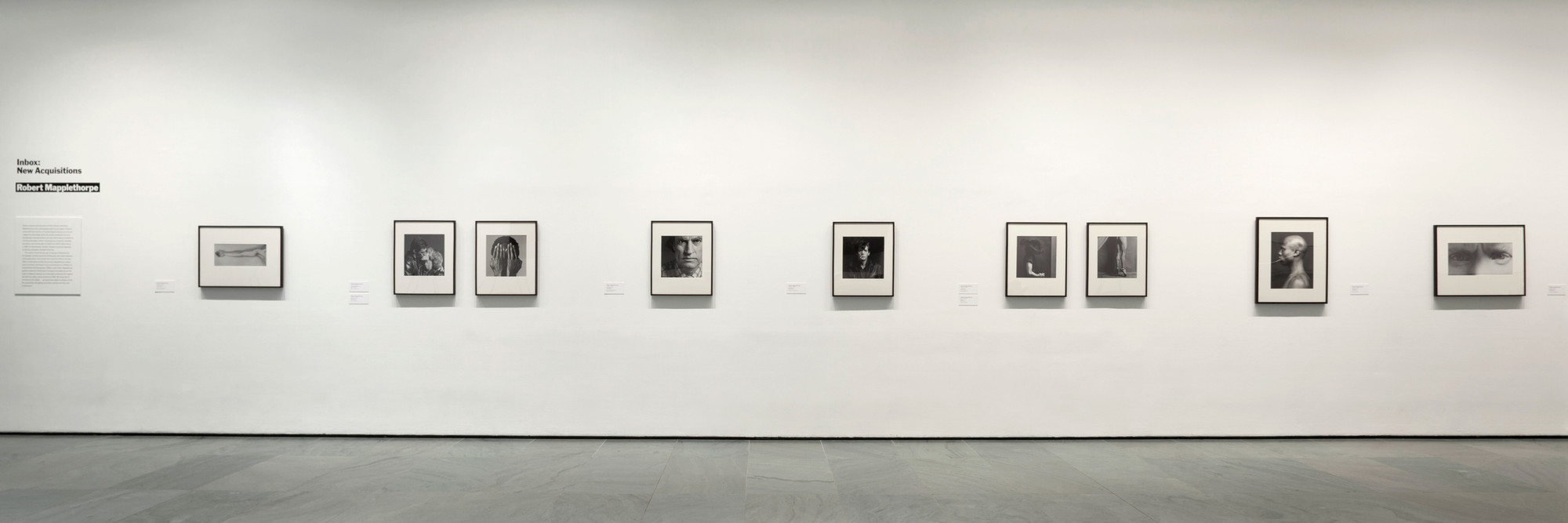
Raised in Queens and educated at Pratt Institute in Brooklyn, Mapplethorpe came to photography when he purchased a Polaroid camera with the intention of incorporating his own pictures into his collage and assemblage works. He quickly transitioned into pure photography, seeking aesthetic precision while taking on sometimes controversial subject matter, including issues of gender, sexuality, and desire. Just months after his death from AIDS-related illness in 1989, his work became central in debates around pornography, censorship, and public funding for the arts.
The works on view here are part of a group of Mapplethorpe photographs recently acquired by the Museum and include examples of his explorations of the human form from the 1970s to the late 1980s. In both early and late self-portraits, Mapplethorpe isolates parts of his body, including his lithe, outstretched arm (1976) or his furrowed brow and piercing eyes (1988). In other works, Mapplethorpe gestures toward the ideal beauty of antiquity; his models assume the poses of classical sculptures and studio lights emphasize their flawless skin and musculature. As he declared in 1988, “My whole point is
to transcend the subject…go beyond the subject somehow, so that the composition, the lighting, all around, reaches a certain point of perfection.”