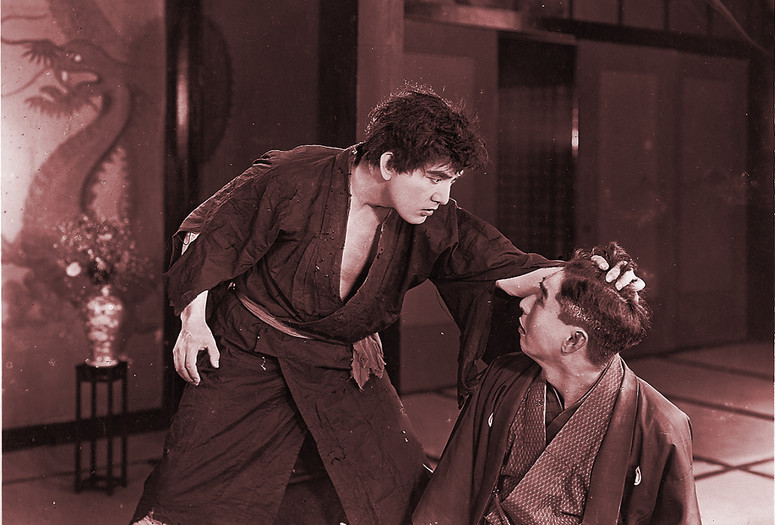
The Dragon Painter. 1919. USA. Directed by William Worthington. Screenplay by Richard Schayer. With Sessue Hayakawa, Tsuru Aoki, Edward Peil Sr. New York premiere. Silent. 61 min.
Like Anna May Wong, the Japanese American movie star and producer Sessue Hayakawa was instrumental in redefining the ways in which Asians were depicted in Hollywood cinema, a story all-too-often marred, now as then, by racist caricature. Yunte Huang, the award-winning author of books on Charlie Chan, the “original Siamese Twins” Chang and Eng Bunker, and now Anna May Wong, presents two films starring Hayakawa. Writing of The Dragon Painter, he observes, “Palming off Yosemite as authentic Japanese mountains, The Dragon Painter is one of the finest productions by Sessue Hayakawa’s Haworth Pictures Corporation. Based on a story by Mary McNeil Fenollosa—widow of the most famous American Japanologist of the era—the film portrays a mad painter who has lived like a savage in the mountains since childhood, searching for his beloved taken away by the spirits and turned into a dragon one thousand years ago. A timeless tale of an artist both blessed and cursed by genius, The Dragon Painter is a cinematic Pygmalion in full Oriental splendor.”
35mm print from the 4K digital restoration by San Francisco Silent Film Festival, Eye Filmmuseum, and George Eastman Museum; courtesy Milestone Films and Kino Lorber.
The Last of the Line. 1914. USA. Directed by Jay Hunt, Thomas H. Ince. Screenplay by C. Gardner Sullivan. With Joe Goodboy, Sessue Hayakawa, Tsuru Aoki. . Silent. 20 min.
Jay Hunt and Thomas H. Ince’s The Last of the Line had a direct influence on Martin Scorsese in making Killers of the Flower Moon. Scorsese recalls, “I want you to see The Last of the Line, which I saw for the first time when I was young, for the presence of real Lakota Natives in many key roles, and for the unusual point of view, which truly expresses the tragedy of Native experience. Interestingly enough, the son of the chief is played by Sessue Hayakawa, who was a great star around that time. In any event, [the film deals with] the destruction of the very fabric of the culture of the Indigenous people, and particularly the guy [Joe Goodboy] who plays the chief. I think he was 80 years old at the time, not an actor. The last image of him mourning his son, it’s as if it just speaks for the loss of all those cultures. There’s something about it, because it has to do with Christian symbolism—and that’s something that always stuck with me.”
35mm preservation courtesy The Museum of Modern Art, with support from the National Endowment for the Arts and Celeste Bartos Fund for Film Preservation.