Were it not for the lifelong heroic efforts of Rick Prelinger, an archivist, filmmaker, writer, and educator, an entire history of American cinema would be largely lost and gone forever: that of so-called “useful,” or purpose-driven, films like advertising, educational shorts, and industrials. In 2002, Prelinger’s remarkable collection of some 60,000 films was acquired by the Library of Congress, a collection that has since grown by tens of thousands with the addition of home movies and film ephemera. As a special guest of To Save and Project, Prelinger presents two self-curated programs featuring some of his favorite sponsored films, most of them shown in his own unique archival prints. He observes, “Today, corporations, associations and government agencies reach people principally through websites. But during the age of film (starting at the dawn of cinema and ending in the 1980s) they reached people through sponsored films—perhaps as many as 300,000 titles, many of which no longer survive. Sponsored films were produced to encourage consumers to buy goods and services, promote companies and organizations, train workers, and strengthen the free-enterprise system. The extant body of sponsored films expresses a near-infinite range of subjects, treatments, and esthetic strategies, which we celebrate in this program.” All descriptions by Rick Prelinger.
This program’s play of genres, including mid-continent noir, industrial musical, corporate spoof, Federal populism, and Cold War scare film, shows the breadth and the surprising course of sponsorship as expressed in non-theatrical film.
Anger at Work: The Story of the Headache Switch. 1956. USA. Produced by University of Oklahoma for Oklahoma State Department of Health. 21 min.
One of a suite of mental health films made in Oklahoma by an accomplished university film unit, this film is full of hints of rural displacement and white-collar discontent.
Round and Round. 1939. USA. Produced by Jam Handy Organization for General Motors Public Relations Staff. 6 min.
Explaining the free market system through puppets, this film was shown at the 1939–40 New York World’s Fair to counter alternative economic theories.
Tuesday in November. 1945. USA. US Office of War Information, Overseas Division. 17 min.
Produced by John Houseman with a score by Virgil Thompson, this artful and beautifully conceived film mixes archival and dramatized images of the 1944 US presidential election into a sophisticated encoding of memes centering on fairness, democracy, and media as a benevolent force.
House in the Middle. 1954. USA. Produced by Robert J. Enders for National Clean-Up Paint-Up Fix-Up Bureau and Federal Civil Defense Administration. 12 min.
One of the odder artifacts of the Cold War era, this film argues that a well-maintained, freshly painted, and clean house is most likely to survive a nuclear attack.
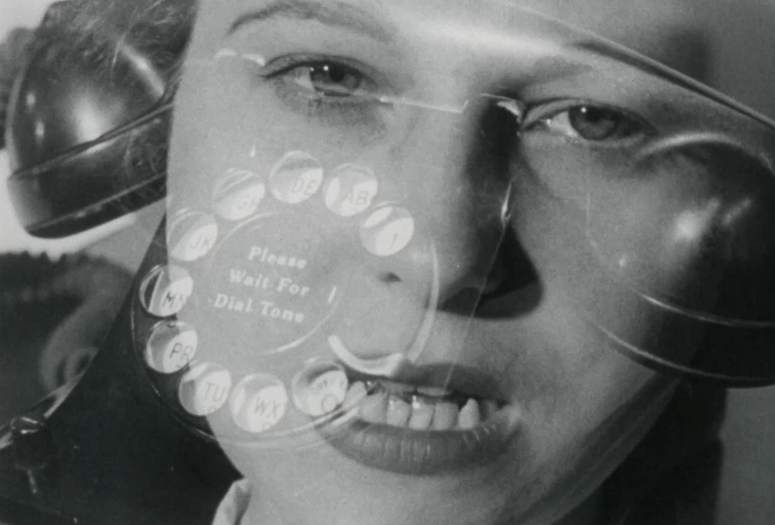
Once upon a Honeymoon. 1956. USA. Produced by Jerry Fairbanks Productions for the Bell System. IB Technicolor. 15 min.
A glittering example of the industrial musical, Once upon a Honeymoon was made to promote color telephone sets for home use. Along the way it introduces a rogue angel, an aging kitchen, creative frustration, and some interesting formulations of gender.
The Your Name Here Story. 1954. USA. Produced by Calvin Productions for the Calvin Workshop. 10 min.
Calvin Productions, a large producer of sponsored films in Kansas City, Missouri, organized a workshop for corporate and institutional film producers from the 1940s through the 1970s, each year producing a self-reflexive film about filmmaking. Made largely of stock footage with a few dramatized scenes, this one pokes fun at the gamut of sponsored film clichés.
Program 81 min.