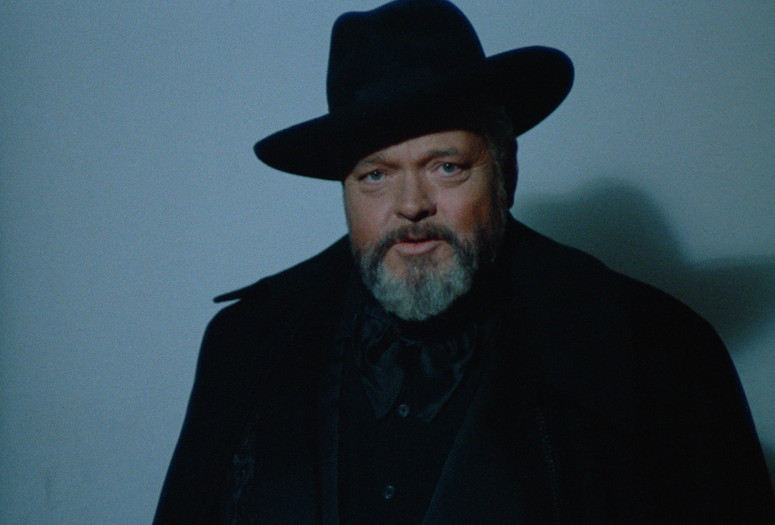
F for Fake. 1973. France/Iran/West Germany. Directed by Orson Welles. Screenplay by Welles, Oja Kodar. With Welles, Kodar, Clifford Irving, Elmyr de Hory, Joseph Cotten, Peter Bogdanovich. 4K digital restoration by the Cinémathèque française, in collaboration with Les Films de l’Astrophore, Documentaire sur grand écran, the Cinémathèque suisse and l’Institut audiovisuel de Monaco, at Hiventy e L.E. Diapason laboratories from the original negative and magnetic sound 35mm print. Courtesy Janus Films. North American premiere. 88 min.
“The first of Orson Welles’s two essay films to be completed and released during his lifetime (the lesser-known 1979 Filming ‘Othello’ was the second), this breezy, low-budget montage—put together from discarded documentary footage by François Reichenbach as well as new material filmed by Welles—forms a kind of dialectic with Welles’s never-completed It’s All True. As Welles himself implied, an equally accurate title for this playful cat-and-mouse game might have been It’s All Lies. The main subjects here are art forger Elmyr de Hory, Clifford Irving, Howard Hughes, Pablo Picasso, and Welles himself; and the name of the game is the practice and meaning of deception…. Welles arguably found a way in F for Fake to contextualize large portions of his career while undermining many cherished beliefs about authorship and the means by which ‘experts,’ ‘God’s own gift to the fakers,’ validate such notions. The key to Welles’s fakery here, as it is throughout his work, is his audience’s imagination and the active collaboration it performs—most often unknowingly—with his own designs, the kind of unconscious or semiconscious complicity that magicians and actors both rely on. As Finnegans Wake was for Joyce, F for Fake was for Welles a playful repository of public history intertwined with private in-jokes as well as duplicitous meanings, an elaborate blend of sense and nonsense that carries us along regardless of what’s actually being said” (Jonathan Rosenbaum).
Ganjineha-ye Gohar (The Crown Jewels of Iran). 1965. Iran. Written and directed by Ebrahim Golestan. 4K digital restoration courtesy Cineteca di Bologna. In Farsi; English subtitles. North American premiere. In Farsi; English subtitles. 15 min.
MoMA presents the North American premiere of a 1965 documentary that, in its original form, was shown only to the Shah of Iran and banned thereafter. Unseen in its uncensored version for more than 50 years, the film has been restored from original camera and sound negatives deposited at Technicolor in Great Britain. The Crown Jewels of Iran “may well be one of the most beautiful color documentaries ever made,” according to the film historian Ehsan Khoshbakht, who oversaw the restoration in collaboration with the now-100-year-old filmmaker Ebrahim Golestan. “Like its title, The Crown Jewels of Iran is a true jewel of Iranian cinema, though [nearly] a buried one. Made for the Central Bank of Iran to celebrate the collection of precious jewels kept in the treasury, this film remains filmmaker Ebrahim Golestan’s most visually dazzling work, embellished with terrific camera movements…. As in his previous ‘commissioned’ films, Golestan manages to subvert the subject by a brave rejection, here, in the form of being openly critical of the Persian kings. The theme of the commentary is in clear contrast with what is shown: colorful images of jewels in rotation while Golstan’s voice is heard, describing the decadence and treachery of past kings.”