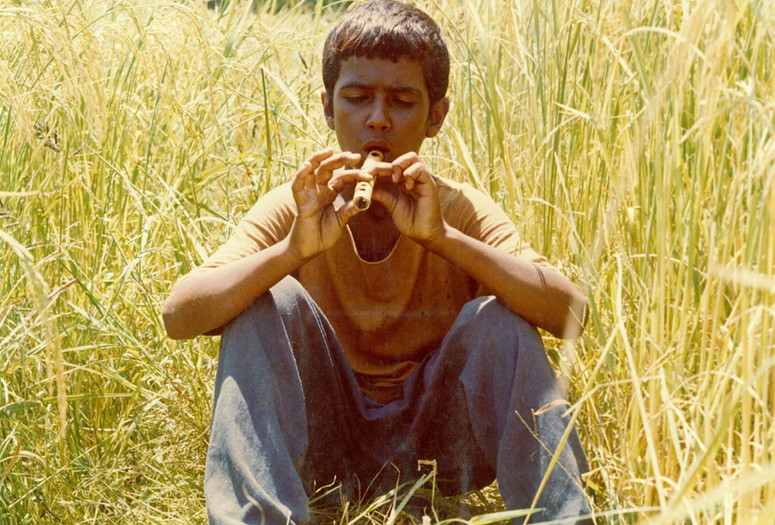
Bashu Gharibeh Kouchak (Bashu, the Little Stranger). 1986. Iran. Written and directed by Bahram Beyzaie. With Soussan Taslimi, Adnan Afravian, Parviz Poorhosseini, Akbar Doudkar, Farrokhlagha Houshmand. US restoration premiere. DCP courtesy mk2 Films. In Persian; English subtitles. 121 min.
Jafar Panahi has called it “a vital cinematic masterpiece” and Mohammad Rasoulof “a window carved from the history and literature of Iran, opening onto a beautiful and spectacular world.” Banned during the Iran-Iraq war but now widely regarded as one of the greatest Iranian films ever made, Bahram Beyzaie’s Bashu, the Little Stranger owes as much to the pathos of Charlie Chaplin as it does to the neorealist humanism of Roberto Rossellini, Vittorio De Sica, and Satyajit Ray. When his parents are killed in a bombing raid, a young Afro-Iranian boy flees northward to a village near the Caspian Sea. Shunned by the native Gilaki speakers who cannot understand his Arabic, mocked for his dark pigmentation, and haunted by visions of his dead family, Bashu, the “little stranger,” finds himself destitute and alone. A chance encounter with a peasant woman, a mother of two whose husband is away (presumably on the battlefront, though it was forbidden to overtly say so), offers the possibility of a place called home. Already established as a master of pre-revolutionary Iranian cinema—his Downpour (1972), The Stranger and the Fog (1974), The Raven (1977), and The Ballad of Tara (1979) were essential to MoMA’s recent historical survey—Beyzaie has brilliantly transformed a classic tale of childhood exile and heroic return into a subversive political allegory. Responding to the film’s restoration premiere in Venice in 2025, Beyzaie observed that “[in 1986], any word that did not glorify the war was met with threats and was strictly forbidden. But was it also forbidden to give refuge to a migrant child fleeing that war? Today, with the utmost humility, I pay tribute to all the innocent victims of that senseless eight-year conflict, and I call down a curse upon all profiteers of every war.”
Restoration in 4K at Roashana Studios with the support of the Institute for the Intellectual Development of Children and Young Adults (Kanoon).
Amou Sibilou (Uncle Mustache). 1970. Iran. Written and directed by Bahram Beyzaie. With Sadegh Bahrami. World restoration premiere. DCP courtesy mk2 Films. In Persian; English subtitles. 28 min.
Steeped in a knowledge of Persian history, art, and literature as well as contemporary theater (he came from a family of prominent poets), Bahram Beyzaie made his first short for Kanoon, the government agency for children’s literacy where other remarkable filmmakers like Abbas Kiarostami and Mohammad Reza Aslani also got their start. With its cast of nonprofessional child actors, Uncle Mustache announces one of Beyzaie’s favorite themes—the anarchical joys of childhood—as a grumpy old man drives away a bunch of rowdy kids and comes to regret it.
Restoration in 4K at Roashana Studios with the support of the Institute for the Intellectual Development of Children and Young Adults (Kanoon).