In association with the new Mellon Foundation–funded Jazz Generations Initiative (JGI), To Save and Project premieres newly restored films from the late 1960s featuring the music and words of three jazz legends: Sun Ra, Cecil Taylor, and Archie Shepp. The program on January 24 is introduced by Robert O’Meally, the co-director (with Courtney Bryan) of that initiative and a longtime professor, author, and curator who founded Columbia’s Center for Jazz Studies in 1999; Manthia Diawara, an acclaimed historian and filmmaker in the field of Black cultural studies; and Henry Threadgill, the Pulitzer Prize–winning composer, musician, and artist. Celebrating the history and performance of jazz and improvised music while also creating it anew, the Jazz Generations Initiative aims to spark cross-generational and cross-disciplinary collaborations in two major American jazz cities, New York and New Orleans.
The Magic Sun. 1968. USA. Directed by Phill Niblock. North American restoration premiere. DCP. 17 min.
A remarkable experimental composer in his own right, Phill Niblock (1933–2024) also worked as a cameraman with dancers and choreographers Yvonne Rainer, Meredith Monk, and Lucinda Childs at the Judson Memorial Church, and collaborated with the Afrofuturist musician Sun Ra and his Arkestra on the astonishingly kinetic 1968 film The Magic Sun. Two years in the making, the 16mm film premiered at Carnegie Hall on April 12 and 13, 1968, as the trippy backdrop to a performance titled The Space Music of Sun Ra. Centre Pompidou curator Jonathan Pouthier, who helped oversee the film’s new restoration, observes, “On screen, the figures gradually dissolve into abstract patterns of dark forms and blinding flashes, while the music surges to a frenzied intensity—a ‘free excursion to the frontiers of sound and vision,’ as described in the announcement for its premiere.”
Restoration carried out at the laboratory Color by Dejonghe in 2025. A new 16mm print and a DCP were produced from a 4K scan of the reversal A and B rolls. As the original magnetic sound mix has not survived, the 16mm optical negative served as the source for the sound restoration, which entailed minor cleaning and noise reduction. Sound and image restoration was led by the film collection department of the Musée national d’art moderne, Centre Pompidou, with the collaboration of, respectively, the audiovisual department and the collections department at Centre Pompidou.
We Came Back (Archie Shepp Chez Tuaregs). 1969. Algeria. Directed by Ghaouti Bendeddouche. With Archie Shepp. US restoration premiere. DCP. 27 min.
Already a key player in the 1960s avant-garde scene through his collaborations with Cecil Taylor, John Coltrane, and Don Cherry, among others, the tenor saxophonist Archie Shepp (together with Pharoah Sanders) moved American jazz toward a greater pan-African consciousness, drawing not only on homegrown spirituals, blues, and big band music but also on the polyvocal and polyrhythmic traditions found, for example, in West Africa among Nigeria’s Yoruba people (jújú) or in North Africa among the nomadic Berber tribes. In July of 1969, Algiers hosted the first Pan-African Cultural Festival to promote solidarity between newly independent African countries and liberation movements worldwide, with performances by Miriam Makeba, Nina Simone, and Archie Shepp and impassioned speeches by Stokely Carmichael, Amílcar Cabral, and Maya Angelou. This film documents Shepp’s spellbinding return to Algeria three months later when, feeling a deep connection to his ancestral roots, he performed with Tuareg musicians in the Sahara.
Restored in 4K in 2023 by La Cinémathèque française, from a 16mm reversal print.
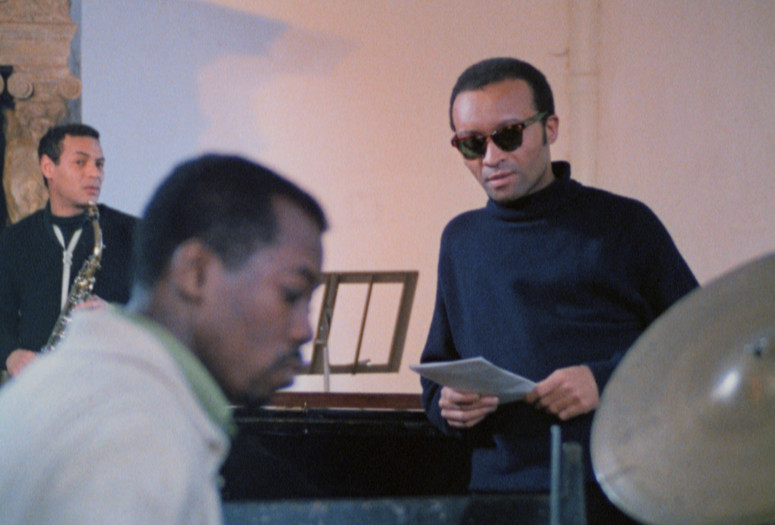
Les grandes répétitions: Cecil Taylor à Paris (Great Rehearsals: Cecil Taylor in Paris). 1968. France. Directed by Gérard Patris. With Cecil Taylor, Andrew Cyrille, Jimmy Lyons. North American restoration premiere. DCP courtesy the Institut National de l’Audiovisuel (INA). In French, English. 45 min.
“‘He doesn’t come from my community,’ replies avant-garde jazz pianist Cecil Taylor, hidden deep behind dark glasses, when asked by the interviewer about Stockhausen. The same response follows for questions about Bach and John Cage. In a style characteristic of 1968, the African-American musician, filmed in an old French palace with oversized chimneys, dismisses European traditions in favour of ‘across the track’ culture–the lived experiences of African-Americans. In this installment in a five-part series for French television on modern music, Taylor discusses the philosophy of music and performance, rendering his points with an opaque, two-handed intensity on the piano that pushes bebop into abstract expressionism, and the film crew into a visceral pool of sound. Gérard Patris and Juliette Bort (as editor) respond with abrupt, rapid cuts, mirroring the music’s intensity with compelling precision” (Ehsan Khoshbakht).
4K digital restoration in 2025 by the Institut National de l’Audiovisuel (INA) from the original 35mm negative and separate optical soundtrack.
Program approx. 89 min.