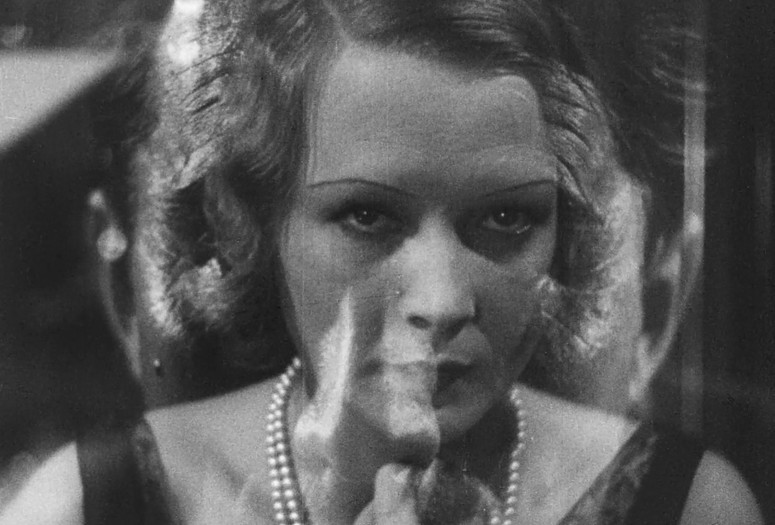
Morgen Beginnt Das Leben (Life Begins Tomorrow). 1933. Germany. Directed by Werner Hochbaum. Screenplay by Carl Behr. With Erich Haußmann, Hilde von Stolz, Harry Frank. World restoration premiere. DCP. In German; English subtitles. 77 min.
One of the great unsung German films of the interwar period, Werner Hochbaum’s Life Begins Tomorrow is as much a portrait of Berlin during the last gasp of the Weimar Republic—frenetic cultural excitement against a backdrop of political and social violence—as it is the story of an everyman ex-convict, a violinist who has served five years for an accidental killing, who grows increasingly desperate and jealous when his wife fails to meet him at the prison gates. Appearing in cinemas in August 1933, only months after the Nazi takeover, the film boldly experiments with stream-of-consciousness storytelling, disorienting movements (a camera unforgettably swings over and across the dance floor), montage (hurtling trains and the sneering faces of neighbors), and a spare use of dialogue and sound to capture the neurotic tensions of a city spiraling into madness. Hochbaum himself was an opportunist for whom “tomorrow” always seemed to spell hardship: He was a World War I army deserter who became a homeless drug addict; was accused (though not convicted, for lack of evidence) of treason in 1923 for offering himself up to the French as a spy; made a pair of antifascist films for the Social Democrats in the late 1920s, as well as a number of finely crafted films in the mid-1930s; and tried but ultimately failed to curry favor with the Nazi regime by making a successful propaganda film for the Wehrmacht in 1938.
Digital restoration in 4K carried out by Bundesarchiv in 2025 based on a 1970 dupe-negative on acetate base.
Preceded by:
KIPHO-FILM. 1925. Germany. Directed by Guido Seeber, Julius Pinschewer. DCP. Silent. 4 min.
Commissioned by the advertising-film producer Julius Pinschewer to promote the 1925 “Kipho” trade show for film and photography in Berlin, the pioneering German cameraman Guido Seeber pulled out all the stops; his “frenzied montage” (Martin Koerber) is a mashup of studio production footage, special effects that he himself developed, and images from Robert Wiene’s The Cabinet of Dr. Caligari (1920), Fritz Lang’s Die Nibelungen (1924), and F. W. Murnau’s The Last Laugh (1924).
2K digital restoration by Deutsche Kinemathek in cooperation with the Bundesarchiv; carried out by ARRI Media (Munich and Berlin) based on an acetate 35mm print from the Bundesarchiv.