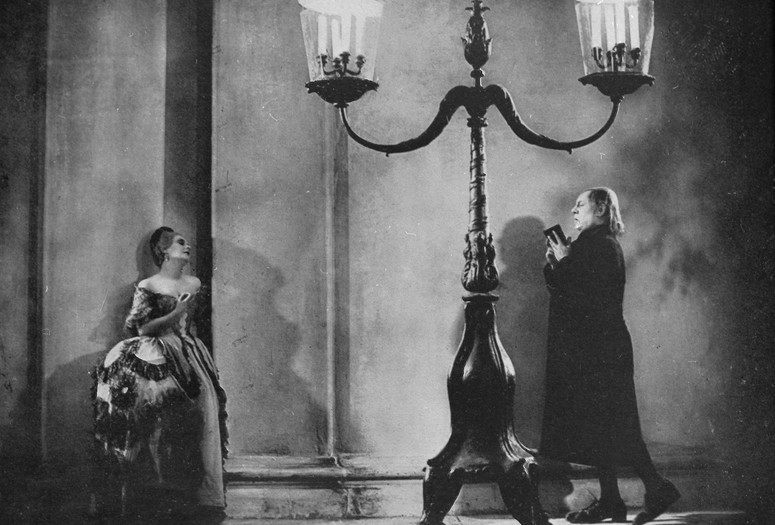
Herr Tartüff (Tartuffe). 1925. Germany. Directed by F. W. Murnau. Screenplay by Carl Mayer, based on the play by Molière. With Emil Jannings, Lil Dagover, Werner Krauss, Hermann Picha, Rosa Valetti. New York restoration premiere. DCP courtesy Kino Lorber. Silent. US version: 64 min, German version: 70 min.
On January 12, Sarah Benson, director of New York Theatre Workshop's new stage production of the classic Molière comedy Tartuffe and Maya Choldin, managing director of New York Theatre Workshop join us to present F. W. Murnau’s silent film adaptation from 1925, starring Emil Jannings, Lil Dagover, and Werner Krauss, in its US release version. The German version is presented for comparison on January 22 so that contemporary audiences can also experience the film as closely as possible to the way Berliners saw it 100 years ago. Perhaps the most underrated of Murnau’s surviving films—he’s best known for Nosferatu, The Last Laugh, Faust, and Sunrise—Tartuffe is bracketed by a modern story involving a scheming, murderous housekeeper, so the Molière play itself is cleverly and self-relexively framed as a film within the film. This is one of the many ingenious narrative and visual conceits that Murnau, cinematographer Karl Freund, and screenwriter Carl Mayer bring to this tale of hypocrisy and falsehood through the ages.
US version:
Four separate negatives of Tartuffe were assembled. One negative was used to strike prints for German release and the remaining three were used for the international markets. Not one of these original negatives survives. A photochemical restoration of the US release version was performed in 2002 by Luciano Berriatúa on behalf of the Friedrich-Wilhelm-Murnau-Stiftung, Wiesbaden. Its basis was a tinted nitrate print preserved by the Library of Congress and donated to the Bundesarchiv-Filmarchiv in Berlin. Labwork was performed by L’Immagine Ritrovata in Bologna. The preservation negative was the basis of this 2K restoration, performed in 2013.
German version:
Four separate negatives of Tartuffe were produced for the German and international markets. One of the export versions survives in its entirety, a duplicate copy preserved by Gosfilmofond, Moscow. It contains German intertitles of unknown origin. For this digital restoration, the image was tinted orange, as usual for export versions. The inserts are tinted yellow, while the intertitles remain black and white. Some insert shots were added from a fragment of the Swiss version, preserved by the Cinémathèque suisse in Lausanne. Additional shots were sourced from a nitrate print of the US version preserved by the Bundesarchiv-Filmarchiv in Berlin.