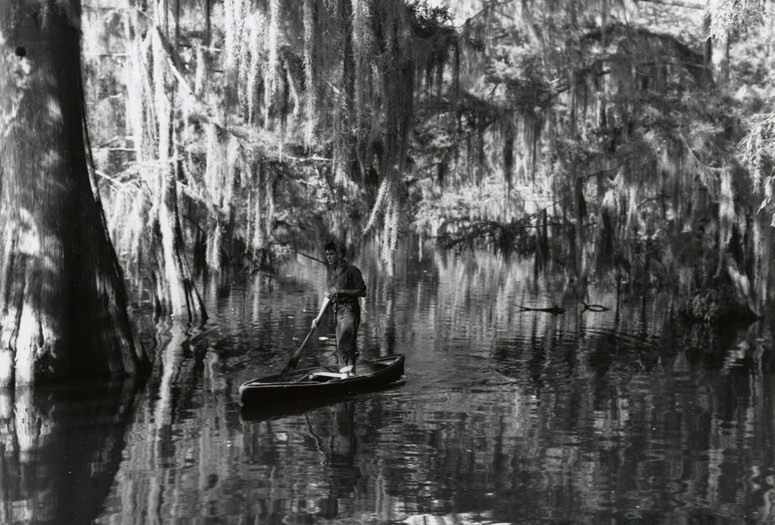
Louisiana Story. 1948. USA. Directed by Robert J. Flaherty. Screenplay by Flaherty, Frances H. Flaherty. With Joseph Boudreaux, Lionel Le Blanc, E. Bienvenu, Frank Hardy. 35mm. 78 min.
Directed by Robert J. Flaherty, with a script co-written by Frances H. Flaherty, this documentary-esque feature, shot on location in the Louisiana Bayou and starring real locals in unvarnished performances, is a strange spectacle. It tells the story of a young Acadian boy named Alexander Napoleon Ulysses LaTour, whose unbound, backwoods life with his pet raccoon is disrupted by the arrival of a group of friendly roughnecks looking to drill for oil nearby.
The film was commissioned by Standard Oil Company, so its political agenda is hardly subtle. But that’s no match for the abundant sense of natural wonder—a villainous alligator, trees dense enough to obscure the sky entirely, water that glitters to life in almost every frame—that undercuts, or at least complicates, the intended message. Largely playing out in swathes of bayou montage and wordless sequences documenting the drilling process (with an extraordinary sensory assist from composer Virgil Thomson, whose music won the only Pulitzer Prize given, to date, to a film score), Louisiana Story is overwhelmed by Flaherty’s sense of fascination. Scene work and paid messaging are subsumed by the director’s own environmental and behavioral curiosity, as the textured beauty of the natural world, and even of the larger-than-life machines on view, becomes the story.