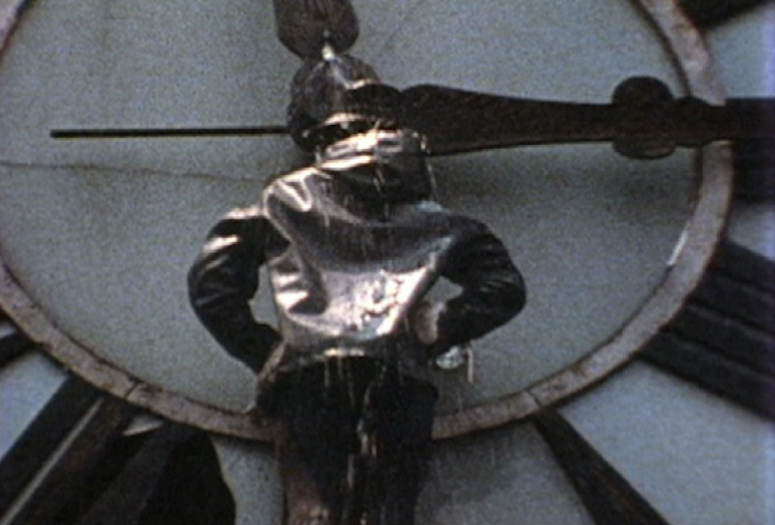
“What I try to express in my films is that time is based on individual and smaller collective histories and is a very malleable and flexible phenomenon,” observes Rosa Barba. Inspired by Barba’s concern for the fluid nature of the public memory, this program brings together works that experiment with time and express the mutability of language and documentary authority. Trinh T. Minh-ha’s Reassemblage upends the expectations of the ethnographic gaze through a poetic visual study set in postcolonial Senegal. Dancer Talley Beatty glides and soars in A Study in Choreography for Camera, Maya Deren’s lyrical examination of the body in motion. Yoko Ono’s Eyeblink (Fluxfilm no. 9) extrapolates time with a slow-motion capture of the artist’s blinking eye, and in Clockshower, Gordon Matta-Clark washes himself, shaves, and brushes his teeth atop the edge of New York City’s Clock Tower building as part of a daring outdoor performance. George Brecht’s Entrance to Exit meditates on duration and perception by way of the appearance of “entrance” and “exit” signs that bracket the film’s transition from a blank white screen that gradually fades to black.
Clockshower. 1973. USA. Directed by Gordon Matta-Clark. 16mm film transferred to video (color, silent). 14 min.
Entrance to Exit. 1965. USA. Directed by George Brecht. Video (black and white, sound). 7 min.
Eyeblink (Fluxfilm no. 9). 1966. Japan. Directed by Yoko Ono. 16mm film (black and white, silent). 5 min.
A Study in Choreography for Camera. 1945. USA. Directed by Maya Deren. 16mm film (black and white, sound). 3 min.
Reassemblage. 1982. USA. Directed by Trinh T. Minh-ha. 16mm film transferred to video (color, sound). 40 min.
Program approx. 61 min.