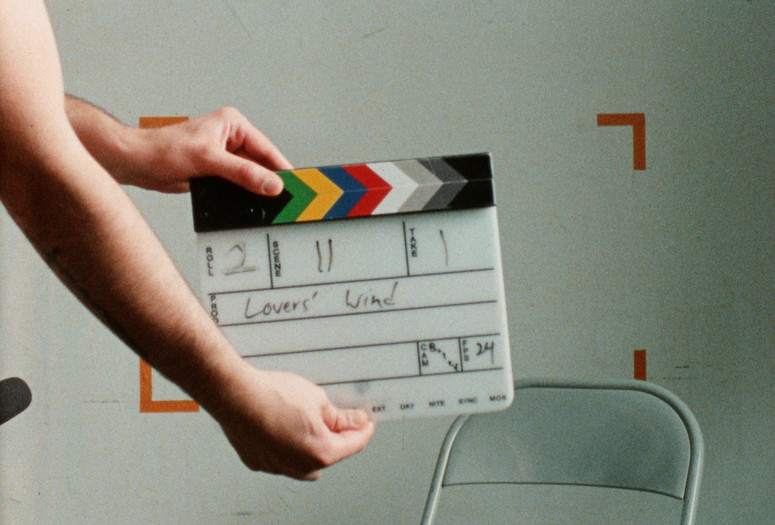
In 1968 the Shah of Iran commissioned Albert Lamorisse, best known for his 1956 short The Red Balloon, to make a documentary touting Iran’s flourishing industrialization. Largely composed of aerial landscapes, Bād-e Sabā, or The Lovers’ Wind (1978), was narrated from the point of view of the region’s northeastern wind—the same winds that led to Lamorisse’s demise, causing his helicopter to crash into the Karaj dam while he was filming supplemental images at the Shah’s behest. This potent tale, unfolding at the cusp of the Iranian Revolution, is the basis for a recent body of work by Parastoo Anoushahpour, Faraz Anoushahpour, and Ryan Ferko, Toronto-based artist-filmmakers who have been working jointly since 2013. First presented as a multi-screen installation at Mercer Union, their excavation both picks up and subverts Lamorisse’s project, reassessing its original aim to document the Iranian condition.
In its single-channel iteration, the Anoushahpours’ and Ferko’s work takes the form of two medium-length films. Their Lovers’ Wind (2024) interlaces elements from the French director’s biography with imagined scenarios shot in Canada, Tunisia, and Iran, teasing out Lamorisse’s legacy as a critical study of myth-making and empire. Postscript (2024) samples from the restored footage retrieved from Lamorisse’s camera, while a phone conversation unfolds between Faraz Anoushahpour and the archivist who oversees the care of Bād-e Sabā’s original reels. As waterlogged fragments fill the screen, the unnamed interlocutor ponders the meaning of the recovered images. As the tenor of the exchange shifts from the archive to shared lore and speculation, new possibilities emerge from the frayed historical record.
The screening will be followed by a conversation with the filmmakers, moderated by Sophie Cavoulacos, associate curator in the Department of Film.
Lovers’ Wind. 2024. 36 min. US premiere
Postscript. 2024. 30 min. US premiere