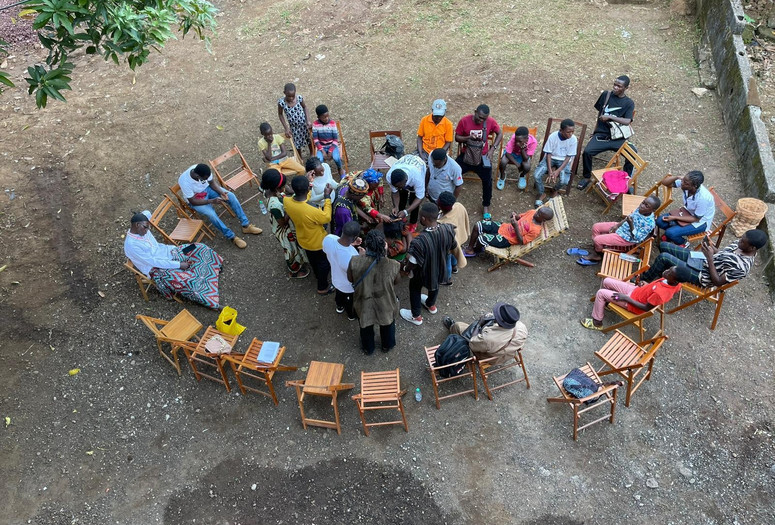
This public program brings together Nancy Adajania, May Adadol Ingawanij, Frida Muenala from Mullu, and Bonaventure Soh Bejeng Ndikung for an evening of inquiry into forms and practices of gathering. The speakers, who represent diverse practices in the cultural fields—from art making to curation to institutional leadership—and operate across vast geographies, will unpack their different approaches to assemblies.
Among the topics that will be discussed are assemblies of the human and other-than-human as collectives, assemblies of materials into collections, and assemblies of spaces and places into shared worlds. The speakers will draw from their engagement with exhibitions, films, public programs, and cultural institutions to map how these forms of assemblies realize the poetic potential of coming together through difference. Assemblies in Uncertain Times offers an opportunity to imagine other futures together, complicating established linearities and teleologies.
Invited speakers will respond to the prompts below, taking into account their own practices:
As cultural producers, how do you create contexts and sites for assemblies?
Can assemblies propose other ways of making art public?
How do assemblies shape our visions of the future and the ways in which we relate to the past?
Can assemblies function as entry points for commoning?
Following the presentations, a discussion will be moderated by Lucy Gallun, Curator, The Robert B. Menschel Department of Photography and C-MAP Bombay/Mumbai Group Leader, and Ugochukwu-Smooth Nzewi, The Steven and Lisa Tananbaum Curator, Department of Painting and Sculpture, and C-MAP Africa Group Leader.
Nancy Adajania is a Bombay-based cultural theorist and curator. She was joint artistic director of the 9th Gwangju Biennale (2012). She has curated a number of exhibitions, including One Hundred Years And Counting: Rescripting KG Subramanyan (Karnataka Chitrakala Parishath, 2025, and Emami/Seagull, 2024) and Woman Is As Woman Does (CSMVS Museum/JNAF, 2022), a first-ever intergenerational mapping of the works of Indian women artists, filmmakers, and activists against the backdrop of the women’s movement in India. Adajania’s writing on the practices of women artists across several generations deploys a transdisciplinary approach, melding art history, feminist theory, anthropology, activism, and philosophy.
May Adadol Ingawanij | เม อาดาดล อิงคะวณิช a writer, curator, Professor of Cinematic Arts, and Co-director of the Centre for Research and Education in Arts and Media, University of Westminster. She works on Southeast Asian contemporary art; de-westernized and decentred histories and genealogies of cinematic arts; avant-garde legacies in Southeast Asia; forms of future-making in contemporary Global South artistic and curatorial practices. She writes in Thai, English, and in translation, for a wide range of academic and arts publications. Her recent curatorial projects include the 69th Flaherty Film Seminar - To Commune, Legacies, and Animistic Apparatus.
Mullu is a digital platform composed of filmmakers, communicators, journalists, and defenders of ancestral territories, deeply rooted and inspired by the worldview of the Indigenous peoples of Abya Yala (Latin America). As a collective, its work reflects the struggles, memories, and identities of these communities. Mullu aims to establish itself as a regional platform for distribution, production, and training, specifically designed to empower creators from Indigenous and Afro-descendant communities, putting these territories at the forefront of the fight for environmental and cultural justice, highlighting their essential role in these global conflicts.
Prof. Dr. Bonaventure Soh Bejeng Ndikung is a curator, author, and biotechnologist who currently serves as director and chief curator of Haus der Kulturen der Welt (HKW) Berlin, Germany, and chief curator of the 36th São Paulo Bienal. He is the founder and former artistic director of SAVVY Contemporary in Berlin, and the artistic director of sonsbeek20–24, a quadrennial contemporary art exhibition in Arnhem, the Netherlands. He also worked as curator-at-large for Adam Szymczyk’s Documenta 14 in Athens, Greece, and Kassel, Germany, in 2017 and was guest curator of the Dak’Art Biennale in Dakar, Senegal, in 2018. Additionally, he served as the artistic director for the 12th and 13th editions of the Bamako Encounters photography biennial in Mali, taking on this role in 2019 and 2022. Together with the Miracle Workers Collective, he curated the Finland Pavilion at the 58th Venice Biennale, in 2019. Prof. Dr. Ndikung was a guest professor in curatorial studies and sound art at the Städelschule in Frankfurt, and he is currently a professor in and head of the faculty of the Spatial Strategies Master’s program at the Weissensee Academy of Art in Berlin. He was the recipient of the first OCAD University International Curators Residency fellowship in Toronto in 2020. His published works include, inter alia, The Delusions of Care (2021), An Ongoing-Offcoming Tale: Ruminations on Art, Culture, Politics and Us/Others (2022), and Pidginization as Curatorial Method (2023).
Due to unforeseen circumstances, Bonaventure Soh Bejeng Ndikung can no longer participate. We apologize for any inconvenience this may cause, and thank you for understanding.
This edition of post Presents is part of the 2025 C-MAP Seminar: Assemblies in Uncertain Times. post: notes on art in a global context is MoMA’s online platform devoted to research on art from a global perspective.
The 2025 C-MAP Seminar is conceived by Diana Iturralde, Cisneros Institute Research Fellow; Beya Othmani, C-MAP Africa Fellow; Carlos Quijon Jr., C-MAP Southeast & East Asia Fellow; and Ananya Sikand, C-MAP Bombay/Mumbai Fellow with support from the International Program: Marta Dansie, Department Coordinator; Jay Levenson, Director; Ksenia Nouril, Assistant Director; and Elena Pérez-Ardá López, C-MAP Program Coordinator.
The C-MAP Seminar is organized in collaboration with the Patricia Phelps de Cisneros Research Institute for the Study of Art from Latin America at MoMA.
Founded in 2009, C-MAP emerged from a long history of international outreach at the Museum. The initiative is currently organized into three research groups that respectively focus on modern and contemporary art produced in the African continent, the city of Bombay/Mumbai, and Southeast and East Asia.
The Museum of Modern Art’s Contemporary and Modern Art Perspectives (C-MAP) initiative, which produces post Presents, is supported by The International Council of The Museum of Modern Art.