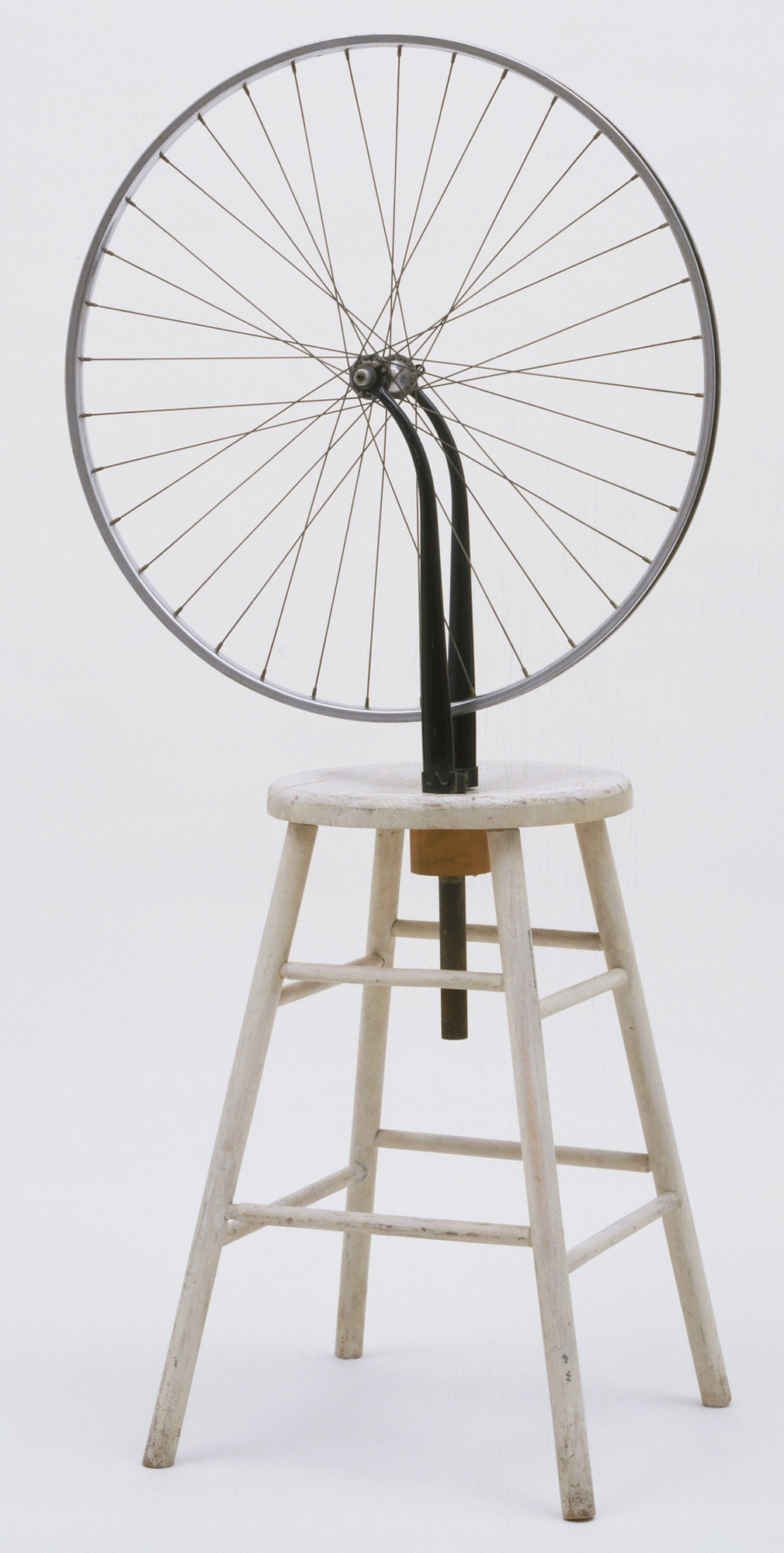
Artist, Marcel Duchamp: The first readymade was in 1913. It was a bicycle wheel. An ordinary wheel on a stand. I would turn it as I passed by. The movement of it, like a fire in the fireplace, it has that attraction of something moving in the room while you think about something else.
Interviewer: Mr. Duchamp, there are two kinds of readymades, those which exist, so to speak, already before you came upon them, and those which you have assisted. Do you put any priority on one kind rather than the other?
Marcel Duchamp: No, no. It was sort of to add a little diversity to the idea.
Curator, Michelle Kuo: The great myth of the readymade is that most often it wasn’t simply readymade. There are pre-assembled elements, but you’ve done things to the object; you’ve altered it slightly. Rather than creating from whole cloth, the act of assembly is the artistic act.
Curator, Ann Temkin: There just wasn’t the language then to say what was a sculpture that wasn’t something that you carved from stone or molded from clay.
Duchamp himself referred to the Readymades as his most important contribution. When you think about the art of the past 50 years, we’re just all breathing Duchamp’s air, because artists today are using store-bought things without a blink of an eye.
Archival audio from: Richard Hamilton and Marcel Duchamp. Art, anti-art: Marcel Duchamp speaks, 1959 October. Colette Roberts Papers and Interviews with Artists, 1918-1971. Archives of American Art, Smithsonian Institution.