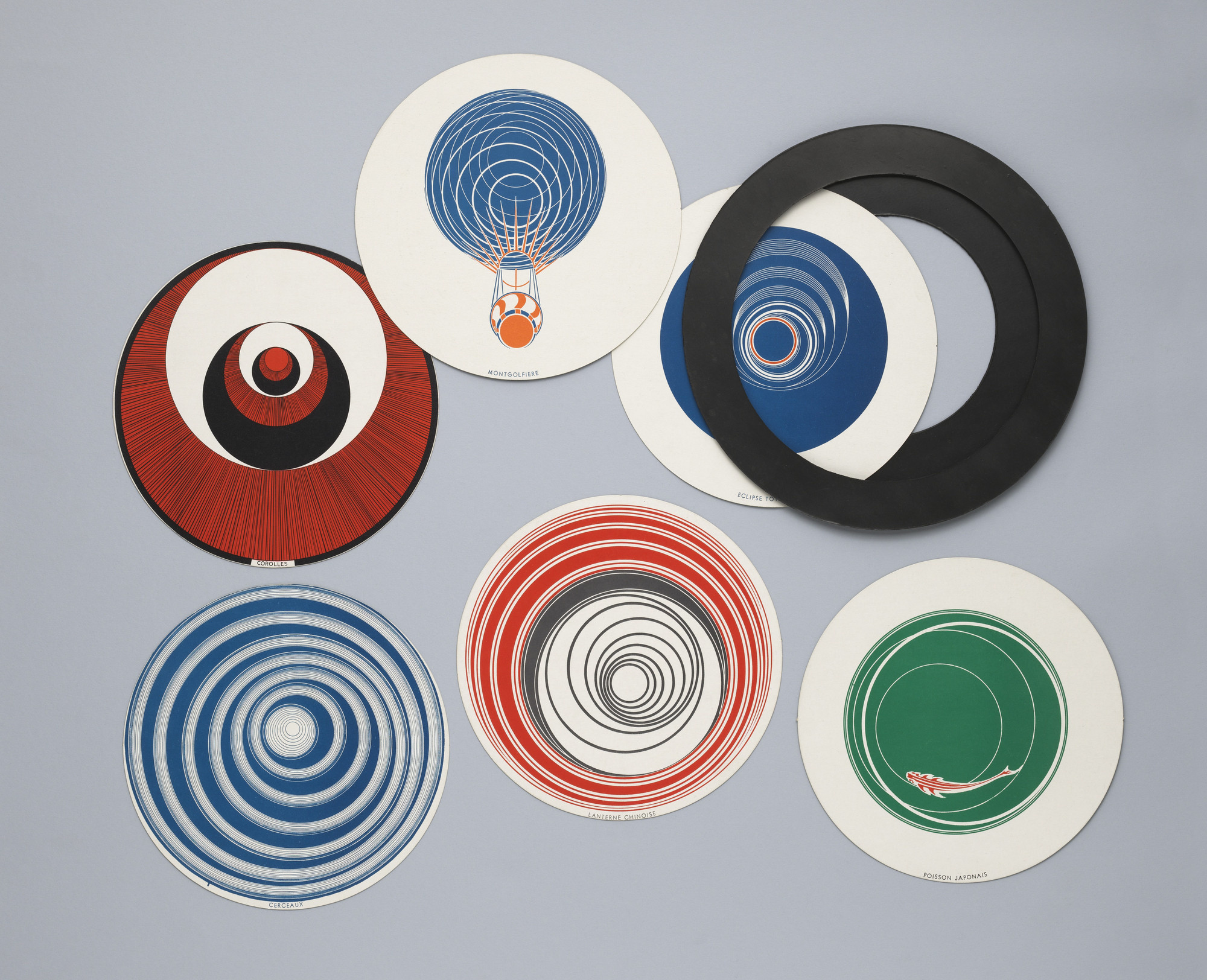
Curator, Michelle Kuo: This gallery has many of Duchamp’s optical devices. He made patterns on discs that would rotate.
Artist, Marcel Duchamp: And the effect is that when you turn them at a certain speed, like 33 and a half turns a minute, you get the effect of a growing form. When it turns, this comes up in [the] third dimension.
Michelle Kuo: They create these kind of pulsating optical illusions of something that is three-dimensionally receding, protruding. And that, of course, has a kind of erotic connotation.
Marcel Duchamp: Eroticism is a very dear subject in my life, in fact, I thought it was [the] only excuse for doing anything, is to give it the life of eroticism. It’s an animal thing that has so many facets that it’s pleasing to inject in your productions.
Artist, Jacqueline Humphries: Seeing this illusion, it’s stimulating. There’s something hypnotic about it, mesmerizing.
Duchamp was very interested in the fourth dimension. We see two dimensions with our eyes, and we see three dimensions with our touch. Fourth dimension could be like seeing inside, outside, and around things. He actually describes sex as a possible fourth dimension. He wants to expand our minds and vision to include those things.
Archival audio from: A Conversation with Marcel Duchamp: from NBC’s Wisdom Series, 1956. New York, N.Y.: Films Media Group, [2010], ©1956