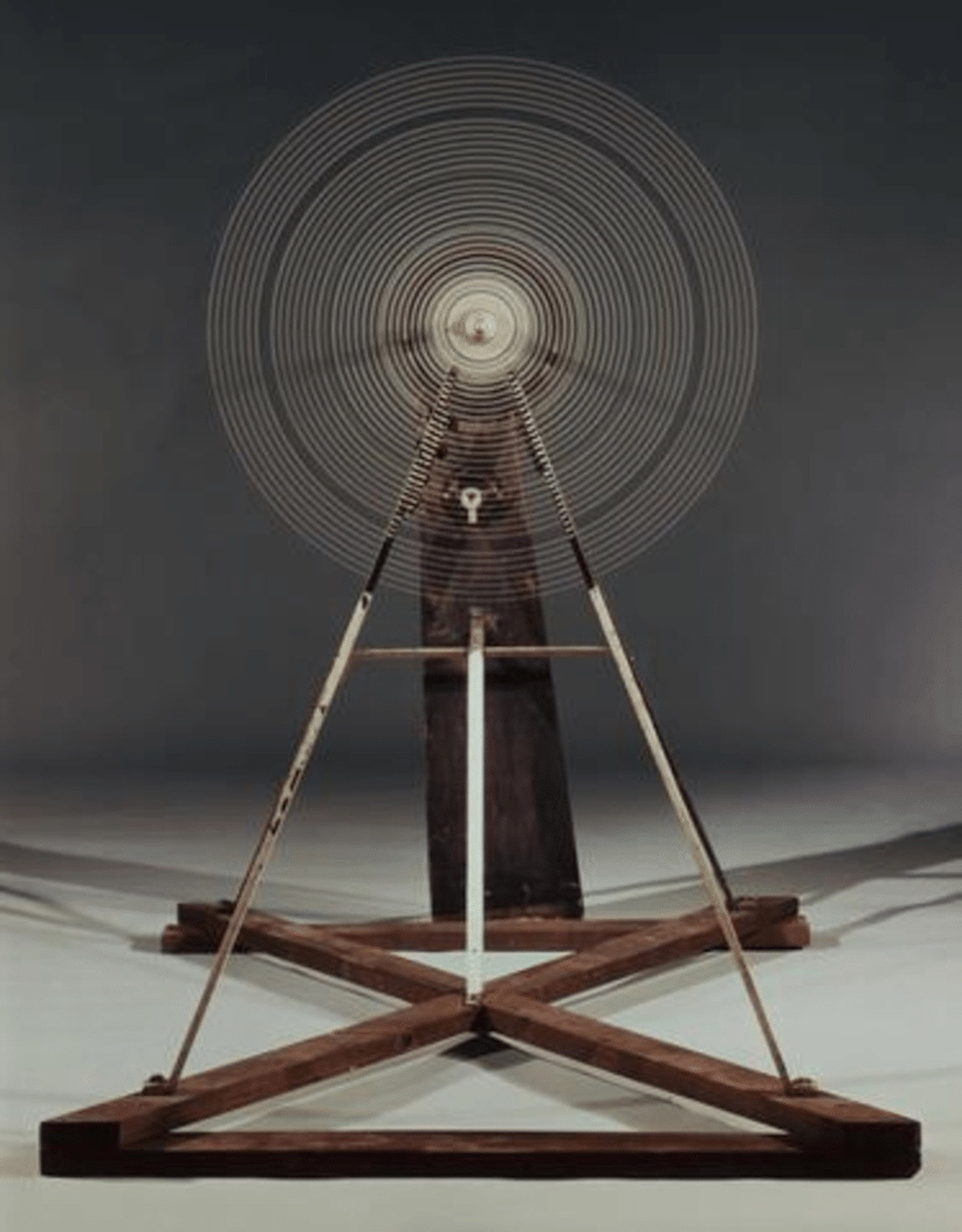
Curator, Ann Temkin: Duchamp really thrived on friendships where he worked very closely with other artists. Man Ray was an American, and one of the projects that they did together was this machine called Rotary Glass Plates, which were these glass plates with spiral designs on them that would make these optical designs spinning in space.
Artist, Marcel Duchamp: We bought a motor that was an accelerating motor. . . . Just by itself accelerates. We didn’t know it. . . . And we put down big plaques of glass, and the motor began to accelerate so much that boom, everything broke.
Ann Temkin: This is Duchamp’s idea that a work of art can actually be more like a toy.
Curator, Michelle Kuo: Duchamp was fascinated by what he called precision optics, basically how certain mechanical devices that were being invented at the time—the microscope, the X-ray—were also creating new ways of seeing the world. Suddenly, human beings have access to realms that were previously invisible.
Ann Temkin: Duchamp said that when he abandoned what he called retinal art—very prettily made paintings—his eyes still needed stimulation, so he turned to optical illusions, machines in motion, to satisfy his eyeballs.
He wanted to complicate the idea of vision, pointing out to people that how we see something is the product of an illusion rather than fact. And of course, that’s not just true about vision, but about our view of the world as a whole.
Archival audio from: Marcel Duchamp and Earl Carter. Interview with Marcel Duchamp conducted by Earl Carter of the Pasadena Museum of Art, 1963 October 20. Marcel Duchamp Retrospective Exhibition records, 1959-1963. Archives of American Art, Smithsonian Institution.