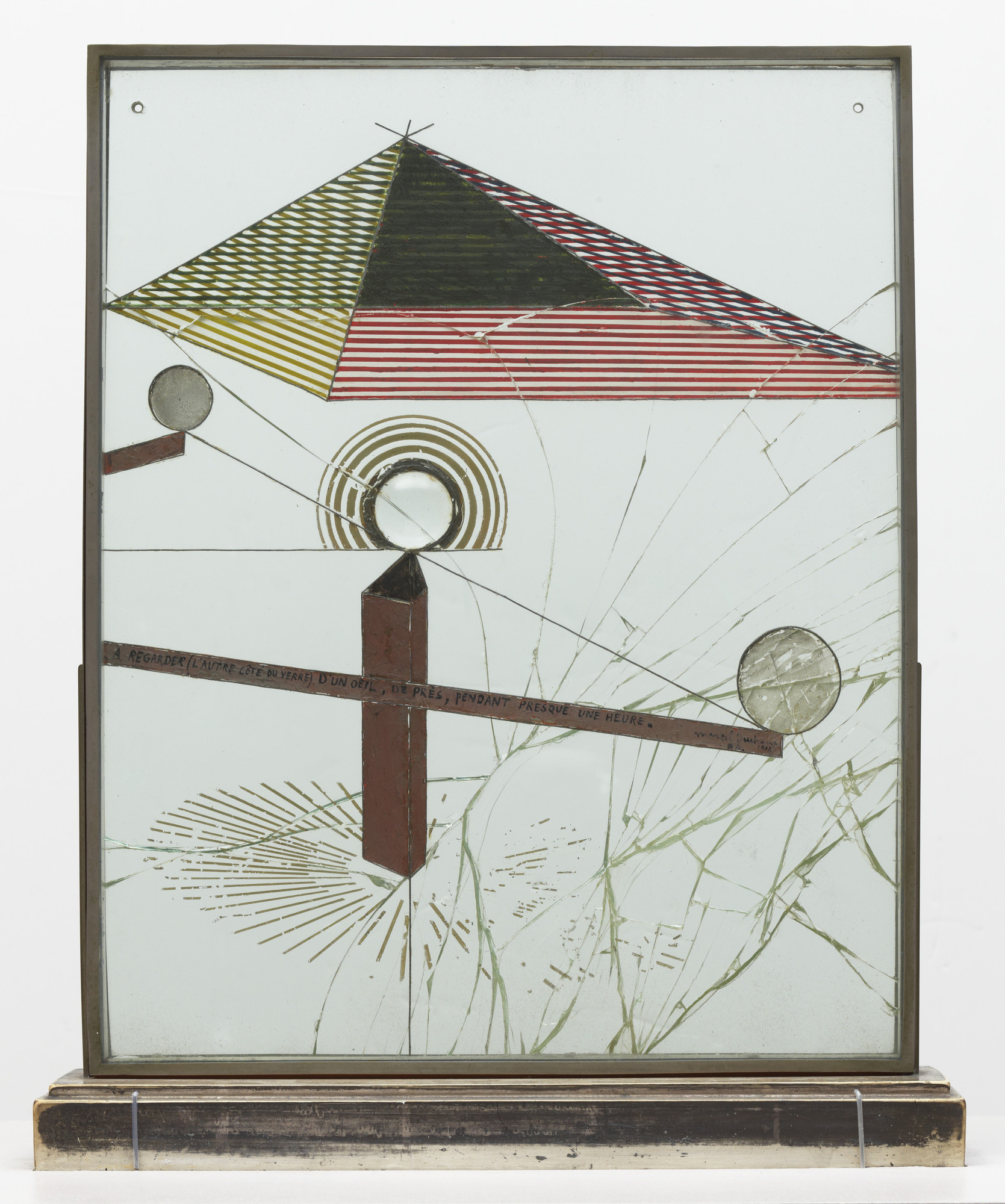
Curator, Michelle Kuo: Duchamp was fascinated by glass and by optical sciences. He created a small glass pane with shapes and lines. In the middle is a little lens that, if you look through it, turns the other side upside down and distorts it. There’s also this set of figures that Duchamp got from optometrist charts, literally a vision test. He called this work To Be Looked at (from the Other Side of the Glass) with One Eye, Close to, for Almost an Hour. And so the joke is that if you look long enough, you might see something [laughs] new or fantastical emerge. But it’s also a way of saying vision actually is a very physical experience.
Duchamp said that the work of art is always dependent on your reception.
Artist, Marcel Duchamp: The creative act is not performed by the artist alone; the spectator brings the work in contact with the external world and thus adds his contribution to the creative act.
Michelle Kuo: When you’re looking through your eye, your eye has certain responses, and your mind is the motor by which the concept of the artwork actually comes into being. That is throwing away centuries of ideas about art as something that is self-sufficient and whole on its own.
Archival audio from: “The Creative Act,” Lecture by Marcel Duchamp, The Convention of the American Federation of Arts, Houston, Texas, 1957.