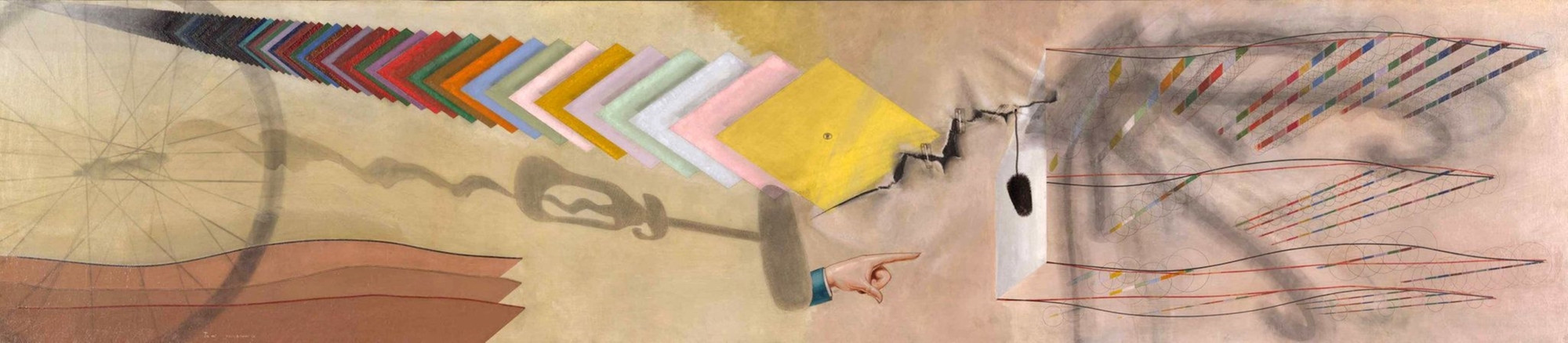
Ann Temkin: This painting entitled Tu m’, is Marcel Duchamp’s last oil on canvas. What you see is an inventory of many of what have now become his most famous works, his readymades, whether it be a bicycle wheel as you see on the far left, or a hat rack as you see on the right.
Artist, Jacqueline Humphries: You see these color cards advancing from the background. And then everything converges in the center, where there’s a hand pointing, which Duchamp hired a sign painter to paint and even had him put his signature there.
My name is Jacqueline Humphries. I’m a painter.
There is a rip in the canvas—it’s a painted rip, but then it’s held together by real safety pins. So there are real objects in the painting, there are illusions of things that fool the eye.
Normally, painting is like a window, and you see through it to what’s on the other side. But he forces you to read it almost like you were reading a comic book—a series of images, which you see this first, that second, that third. It’s all a kind of game, which is meant to engage us in a process of thinking.
I think Duchamp didn’t believe in art. He believed that art is a medium of thought. You can see already in Tu m’ that a painting cannot contain the expansive vision that Duchamp wanted to bring to his art. And having done that, he stops painting, and moves into other forms of artistic activity that hadn’t existed before.