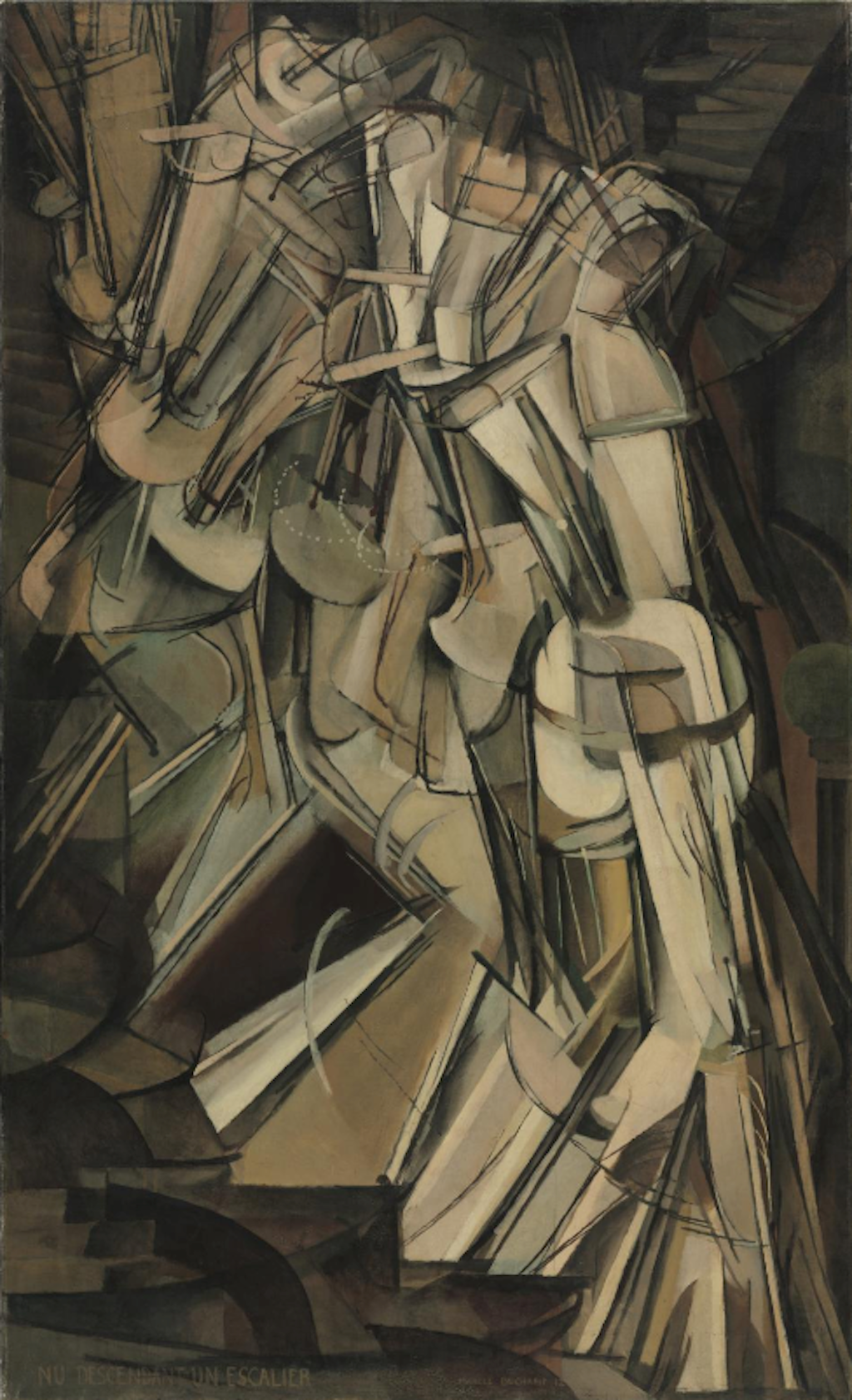
Art Historian, James Johnson Sweeney: You had several versions of Nude Descending a Staircase, didn’t you?
Artist, Marcel Duchamp: Yes, three. But this one is the first one that was shown—
James Johnson Sweeney: —the one the newspaper man called “an explosion in a shingle factory.”
Marcel Duchamp: Ha! Yes. That was a really great line…
Curator, Ann Temkin: With Nude Descending a Staircase (No. 2), he made the painting for an exhibition, supposedly in which all works were accepted. But his two brothers, who were on the committee running this exhibition, told him that the committee was not happy about this work.
Curator, Michelle Kuo: The nude figure, rather than being elegant, looks like some mechanical set of devices.
Ann Temkin: He was angry. He withdrew the painting. But just a year later, it’s selected for the Armory Show, which is this important exhibition introducing avant-garde European art to American audiences. The Armory Show had dozens of paintings and sculptures, a lot of which earned negative reaction. But for some reason, this one painting became the poster child of crazy new art.
Michelle Kuo: It was his first brush with wide-scale notoriety, and it is the subject of many headlines, some of which I find hilarious, like: “the most freakish of the freak art is on display.” [Laughs]
Artist, Marcel Duchamp: When you do anything like that, which goes [on] to become a shocking piece, you don’t know that you’re doing in the first place. I’m not responsible for the shock. The spectator is responsible for the shock. He made the shocking thing by declaring it was shocking.
Archival audio from: A Conversation with Marcel Duchamp: from NBC’s Wisdom Series, 1956. New York, N.Y.: Films Media Group, [2010], ©1956; and Marcel Duchamp and Earl Carter. Interview with Marcel Duchamp conducted by Earl Carter of the Pasadena Museum of Art, 1963 October 20. Marcel Duchamp Retrospective Exhibition records, 1959-1963. Archives of American Art, Smithsonian Institution.