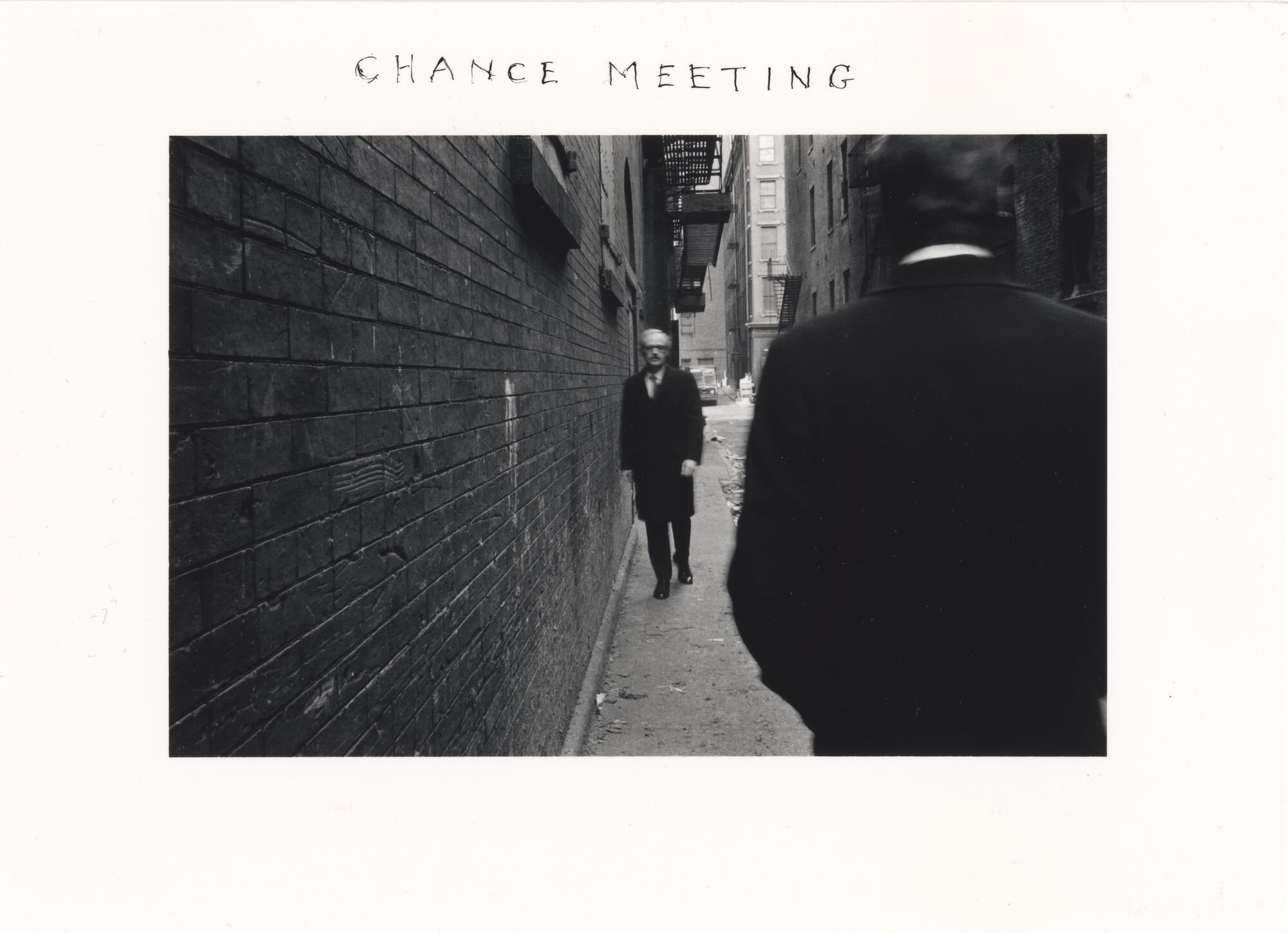
Artist, Duane Michals: When you look at the first picture, you have no idea what’s happening here. And then, very slowly, it unfolds. In six pictures, you could express a lot.
Curatorial Assistant, Samuel Allen: This is a work by Duane Michals titled Chance Meeting.
In the late 1960s, Michals began creating photographic sequences, and they function almost like film stills, unfolding a narrative. Chance Meeting restages the experience of encountering someone on the street and realizing, belatedly, that you have some kind of connection to them. But we can also read the glances that pass between the two men in this artwork as desiring glances. Perhaps they’ve moved into a covert place to search for something that’s not publicly condoned.
Duane Michals: In my day, being gay wasn’t an option. The idea of somebody would be attracted to other men—I didn’t even know what that was. When I did my work, it’s about the legitimacy of affection between people of the same gender.
Samuel Allen: When Michals began with photography, the predominant way of working was this idea of the “decisive moment.”
Duane Michals: And it only meant one thing: observable reality. But what about my reality? My dreams, my anxieties, my sexual fantasies? All [of] which I found more legitimate. I thought that photography should deal with the entire range of experience. So therefore, the subjects I chose were things that I knew intimately.
Archival audio from: Oral history interview with Duane Michals, 2016 June 7-23. Archives of American Art, Smithsonian Institution.