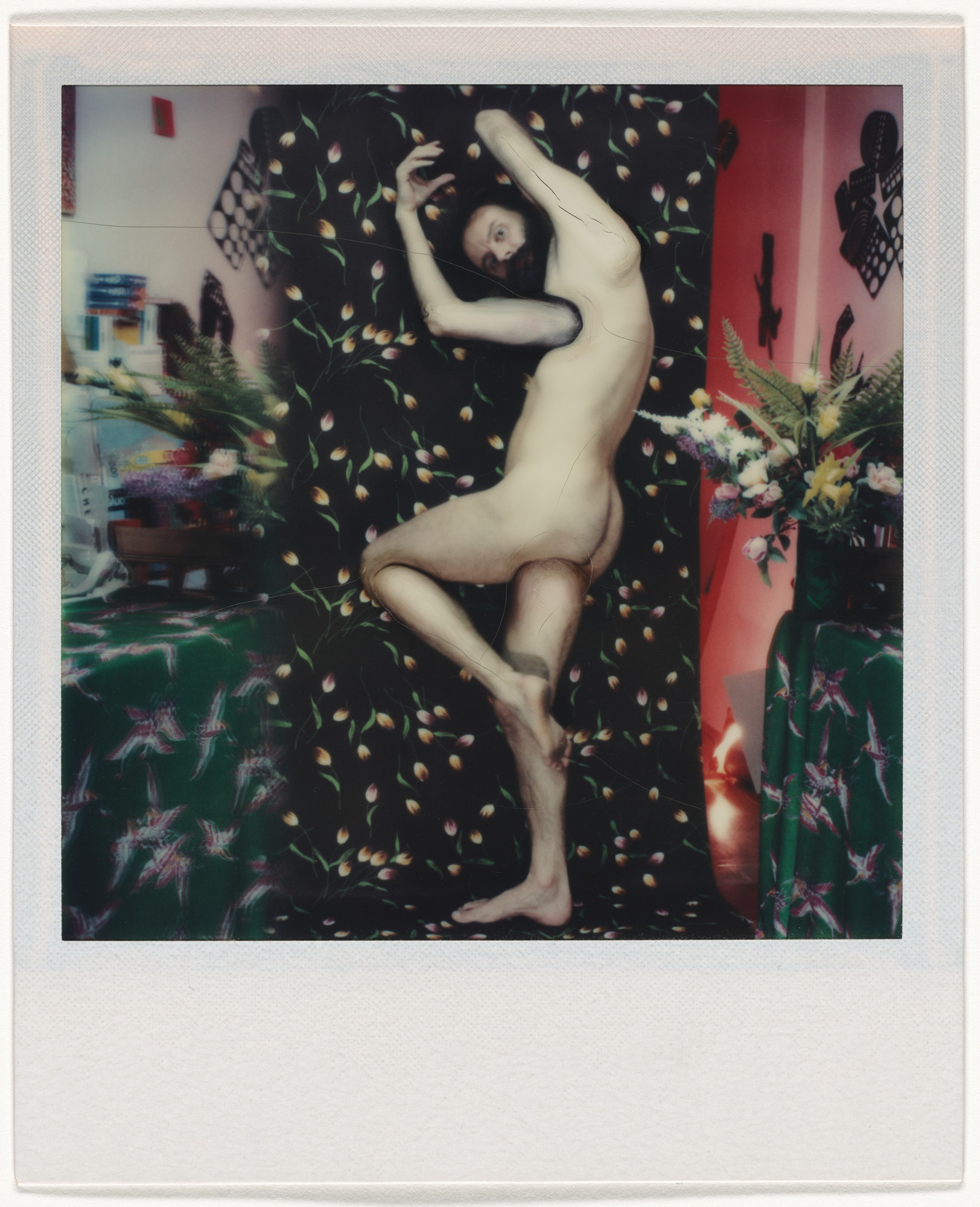
Artist, Lucas Samaras: Narcissism has negative connotations. “Don’t look in the mirror,” and so on. When you do then seriously look in the mirror, you know, you look in the mirror, you say, “Wow, what is it? Who am I? What the hell is this?” That discovery is important to me.
Curatorial Assistant, Samuel Allen: This is a work by Lucas Samaras from his series of Photo-Transformations. Autobiography was a central element of Samaras’s work pretty much from the beginning. And the starting point for a lot of his Polaroid works is being alone and performing for the camera, contorting his body, wearing costumes, lighting himself in different ways.
Lucas Samaras: You have to face certain facts about yourself. Once I started photographing myself, I could see portions of myself that I hadn’t seen before. When I see a side view, I’m not used to it. I would say, “Hmm, it’s a little peculiar.” It becomes an interesting psychological confrontation.
Samuel Allen: In the early 1970s, Samaras began working with a newer model of Polaroid instant camera: the SX-70. One thing that Samaras learned about the prints that were produced by this camera is that their chemicals stay soft for up to 24 hours, which means that if you take your finger or a pencil, you can push around the image material and shape it into all of these new forms. In this photograph, you can see how he’s made it appear as if some of the joints of his arm and his leg are disconnected from his body.
It’s about expressing all of the possibilities that might reside within himself. All these ways of being that you can’t necessarily be in the world, you can be for a photograph.
Archival audio from: Oral history interview with Lucas Samaras, 1968 January 18. Archives of American Art, Smithsonian Institution.