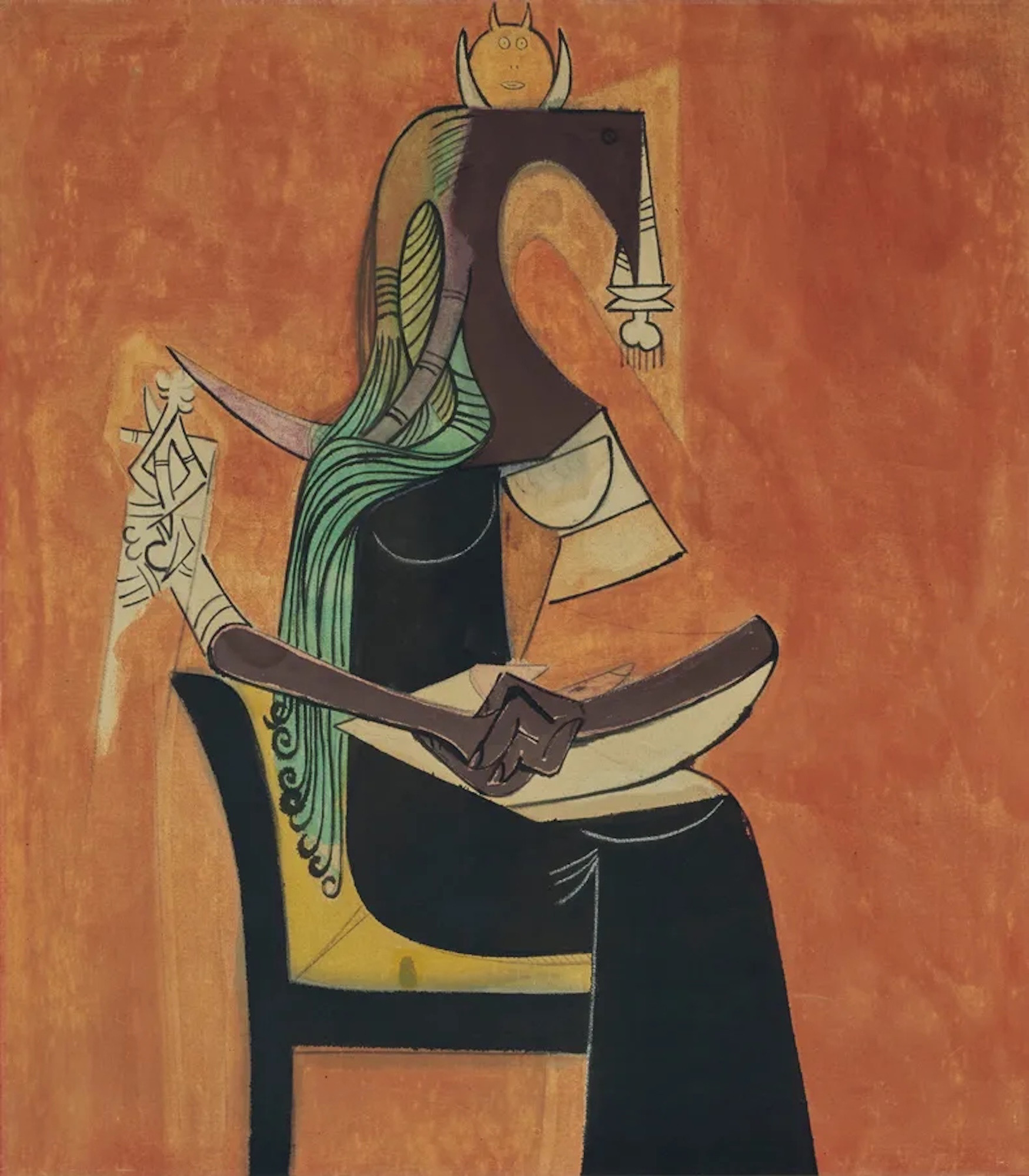
Narrator, Marlin Ramos: This painting features the figure of a horse-woman. The idea stems from Afro-Cuban religions. In these traditions, initiates participate in ceremonies where their bodies are possessed by spirits, called orishas.
Martin Tsang is an anthropologist and a practitioner of Afro-Cuban religions.
Anthropologist, Martin Tsang: One of the ways that possession is described is the orisha temporarily coming to earth, and mounting the person, as a horse, as un caballo. This idea is a recurring motif through Lam's work, and I see the iconography or the symbolism of the femme-cheval as echoing the importance of women within Afro-Cuban religious spaces. Afro-Cuban women were the keepers of knowledge. They would lead ceremonies, communities, initiations.
Marlin Ramos: Two women were central to Lam's spiritual education. His friend Lydia Cabrera, who documented the rites and traditions of Afro-Cuban religions, and his first spiritual guide, who came in childhood.
Martin Tsang: Lam had a godmother called Ma'Antoñica Wilson. “Ma” is an honorific which could be short for mama, for mother, or madrina, godmother. We know that Antoñica Wilson was a very well-respected Iyalorisha, which is a priestess of the orishas. She would have been in charge of Lam's spiritual wellbeing. It was through her auspices that we see Lam being able to get an intimate relationship with the iconography, symbolism, materiality that is part of Afro-Cuban religions.