Curator, Smooth Nzewi: Lam was an activist. He was thinking of a world outside the system created by European powers in that moment, and he lent his voice, he lent his art to the struggle.
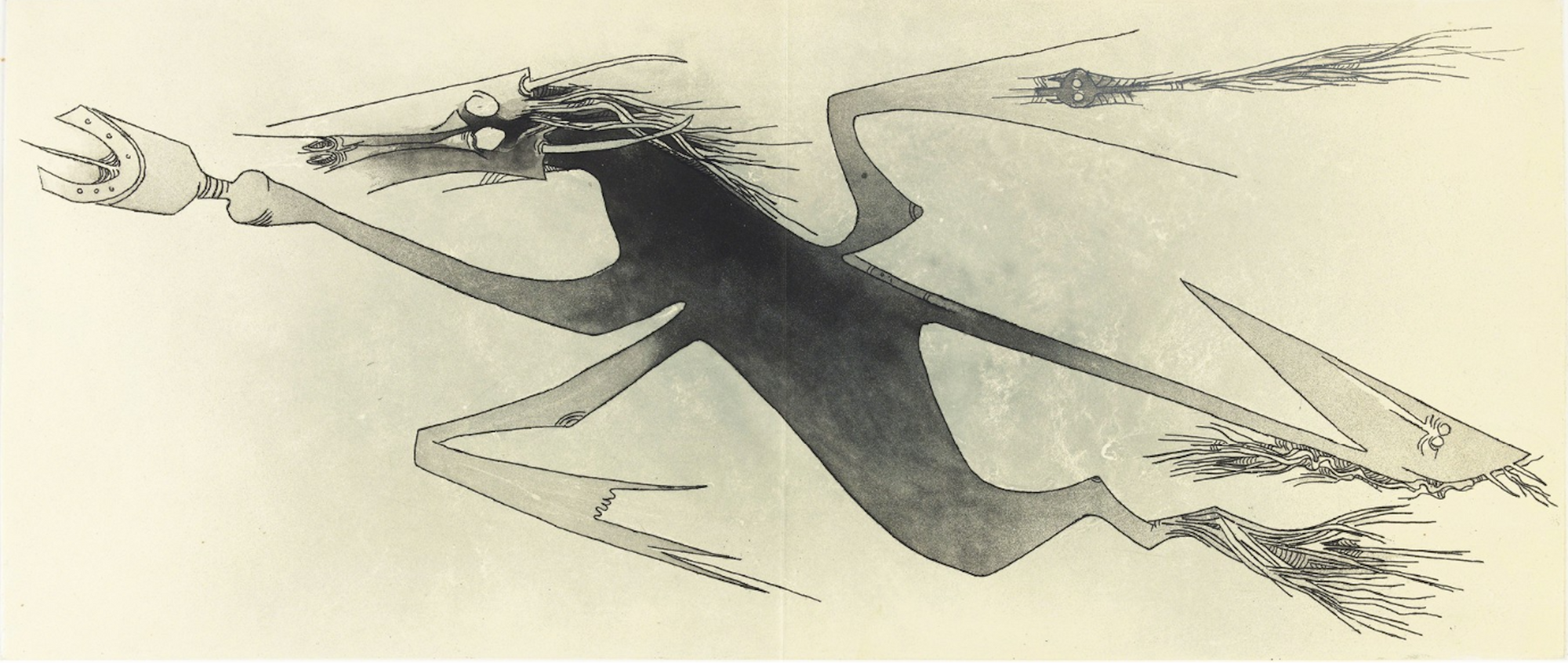
Narrator, Marlin Ramos: Toward the end of his life, Lam expanded his practice to include printmaking. This portfolio of prints was done in collaboration with the Romanian poet Ghérasim Luca. Both artists were deeply engaged with politics, and they inspired one another.
Titled Apostroph'Apocalypse, the poem is based on the idea of an apostrophe breaking words apart into atomic particles.
Historian, Ada Ferrer: The faces, some of the spikes coming out of the stalks, all the heads are pointing downward—they're beaten down. They seem like they're about destruction to me.
Lam was working on this print portfolio against the backdrop of the Cuban Missile Crisis, which could have destroyed the world as we know it, and it came close to doing that.
The Cuban revolution came to power in January 1959, under the leadership of Fidel Castro. The US and Cuba, their relationship had been becoming more and more tense. Both Castro and the Soviet Union believed that the US would invade Cuba, so the Soviet Union put missiles in Cuba. In the end, the Soviet Union agrees to withdraw the missiles.
But it's a hugely important event. The Cuban soldiers had said to their Soviet counterparts something like, when the island sinks, please put a floating memorial in the Caribbean Sea to show where Cuba used to be. Gives you a sense of what people thought might happen.