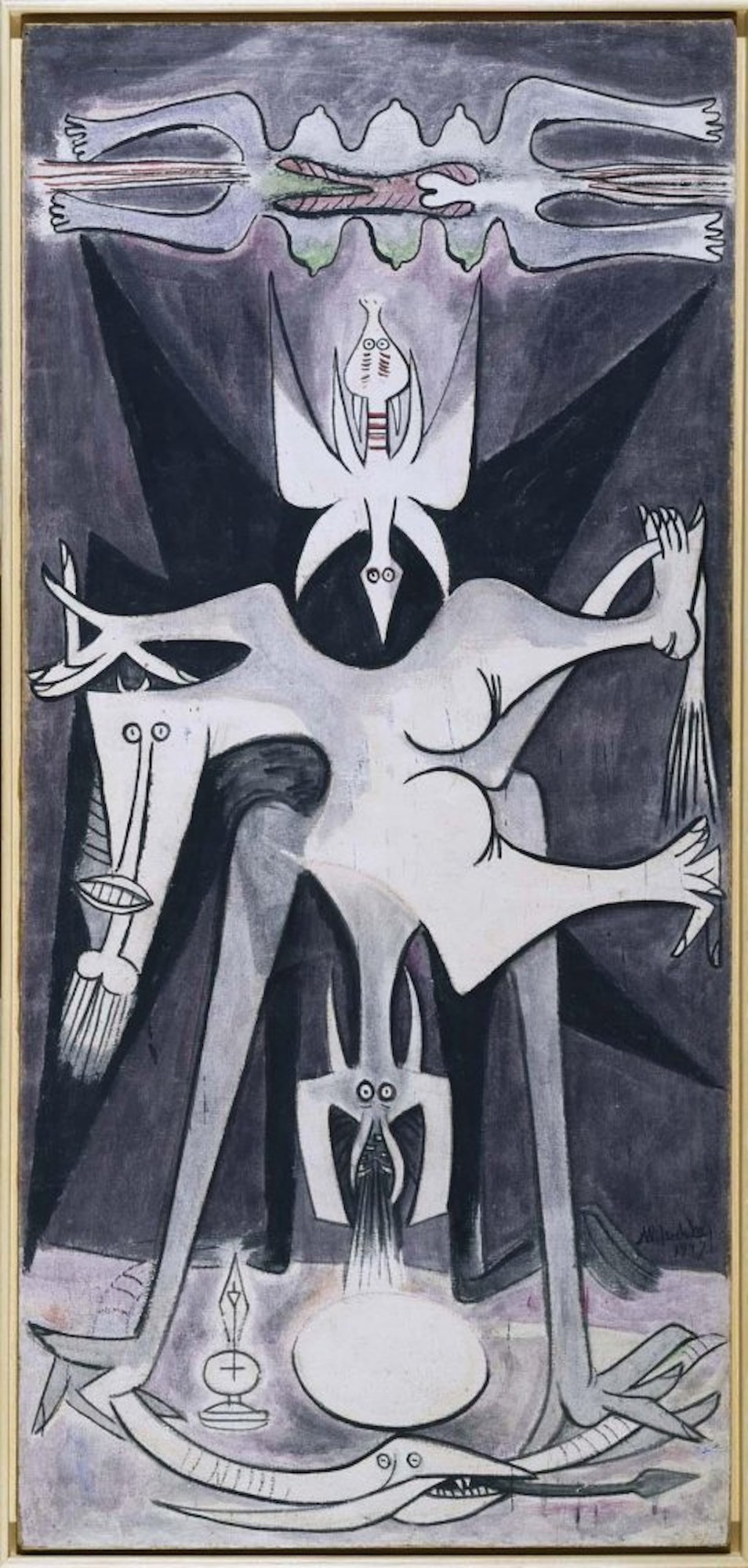
Ecologist, Leo Douglas: If you look to the bottom of this work, you'll notice an egg. Eggs are used spiritually across the Caribbean to represent the rebirth, the hope, and visions of what the future could be.
Narrator, Marlin Ramos: This work is titled Nativity, and it expresses the idea of rebirth that was especially important to Lam in the 1940s.
Curatorial Associate, Damasia Lacroze: Confronting Paris in the aftermath of World War II had a deep impact on Lam. His paintings took a new force. They became darker and more dramatic and differ significantly from the vibrant, colorful paintings of the first half of the 1940s.
Marlin Ramos: Lam didn’t want to be pigeon-holed as the painter of lush, Caribbean landscapes. He had bigger ambitions.
Curator, Smooth Nzewi:
Curator, Smooth Nzewi: After the end of the Second World War, and the horrors that came out of the war, artists, intellectuals were trying to make sense of the world. But also, there was a set of artists, activists, who were fully involved in the rise of anti-colonialism and liberation struggle around the world. And Lam was such a central figure in that. They had ambitions for world-making, creating a world that reflected new values.
Marlin Ramos: Interested in this idea of starting anew, Lam references the Christian story of Jesus’s birth here, but with unexpected imagery.
Leo R. Douglas: He is depicting a traditional, sacred scene and flipping it in this way, where there are horns and tails and various other things which we would never expect to see within the context of a nativity scene. It’s asking us to think through a more global lens, what rebirth, nativity, sacredness might mean to those who are not Western.