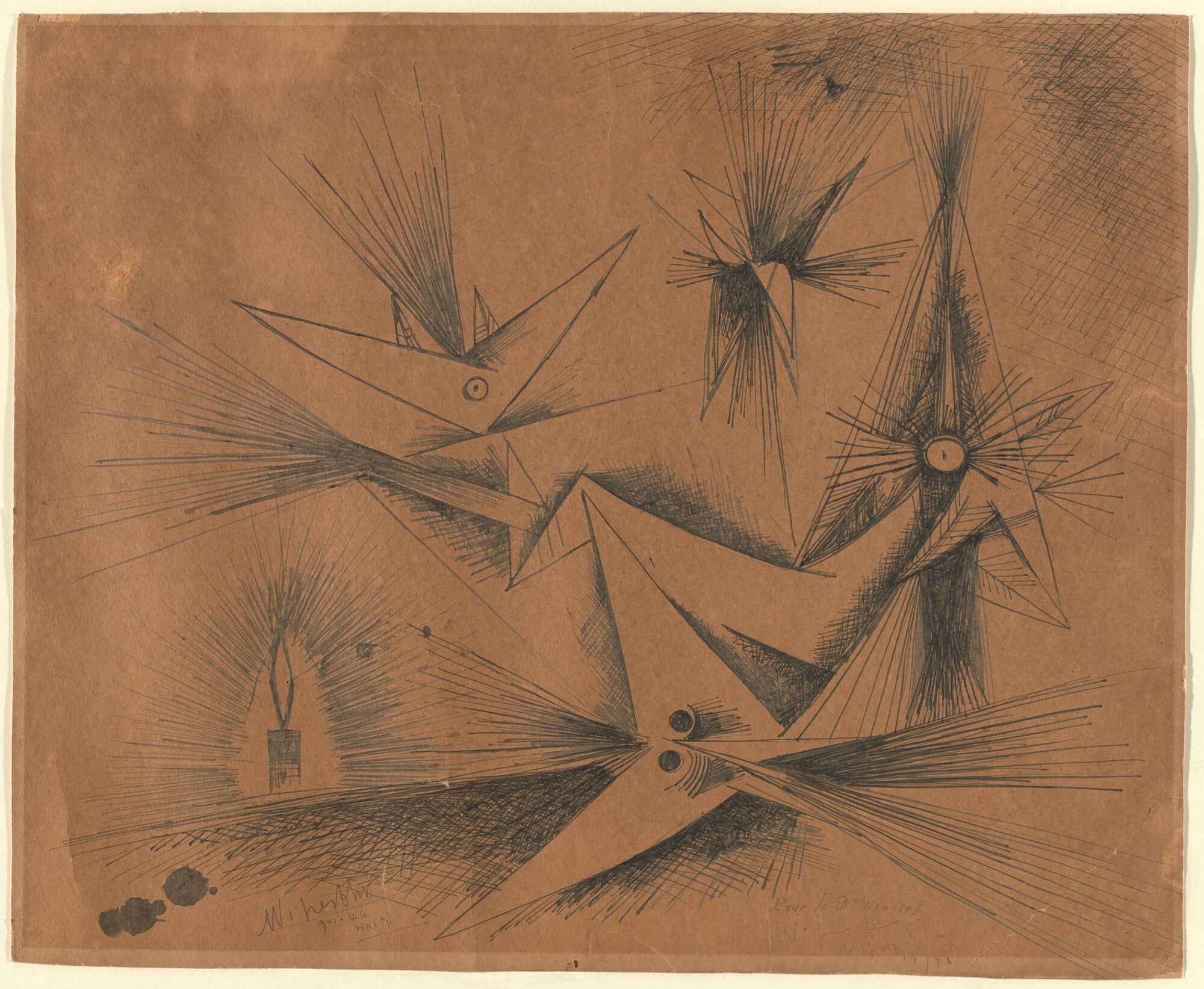
Narrator, Marlin Ramos: Lam often drew when he traveled, creating a distinctive body of work in each place he visited. Between 1945 and 1946, he spent nearly five months in Haiti, where he made these pen and ink drawings, characterized by fine, repetitive, or sharp lines.
Lam also met with artists and writers during this trip and experienced Haitian religious ceremonies.
Historian, Ada Ferrer: The capital city of Port-au-Prince was a centrifuge of the Black literary and artistic world. You had visitors from the US, Europe, from the rest of the Caribbean and Latin America, so it was this meeting place for all these exciting figures.
Anthropologist, Martin Tsang: Lam's time in Haiti was incredibly important for experiencing the religious sphere called Haitian Vodou, which was much more public in Haiti than it was in Cuba at that time. So, Lam would have been inspired by this celebration of Blackness that is tied into revolutionary ideas.
Marlin Ramos: He soon realized that Haiti and Cuba shared the same struggle for freedom.
Ada Ferrer: At the end of the 18th century, you had the Haitian Revolution, that ultimately produced the independence of Haiti from France in 1804. So Haiti stood as an emblem of Black freedom. And when Lam went to Haiti in 1945, that was the Haiti that he was seeking and that he found.
The Caribbean was colonized by different European nations, the languages are different, but there's so much overlap in terms of the history and continuing forms of colonialism. So, I think what they're doing in Haiti is talking about all that and giving each other ideas and sustenance, thinking about the decolonizing world in ways that go beyond these vertical lines to mother countries.