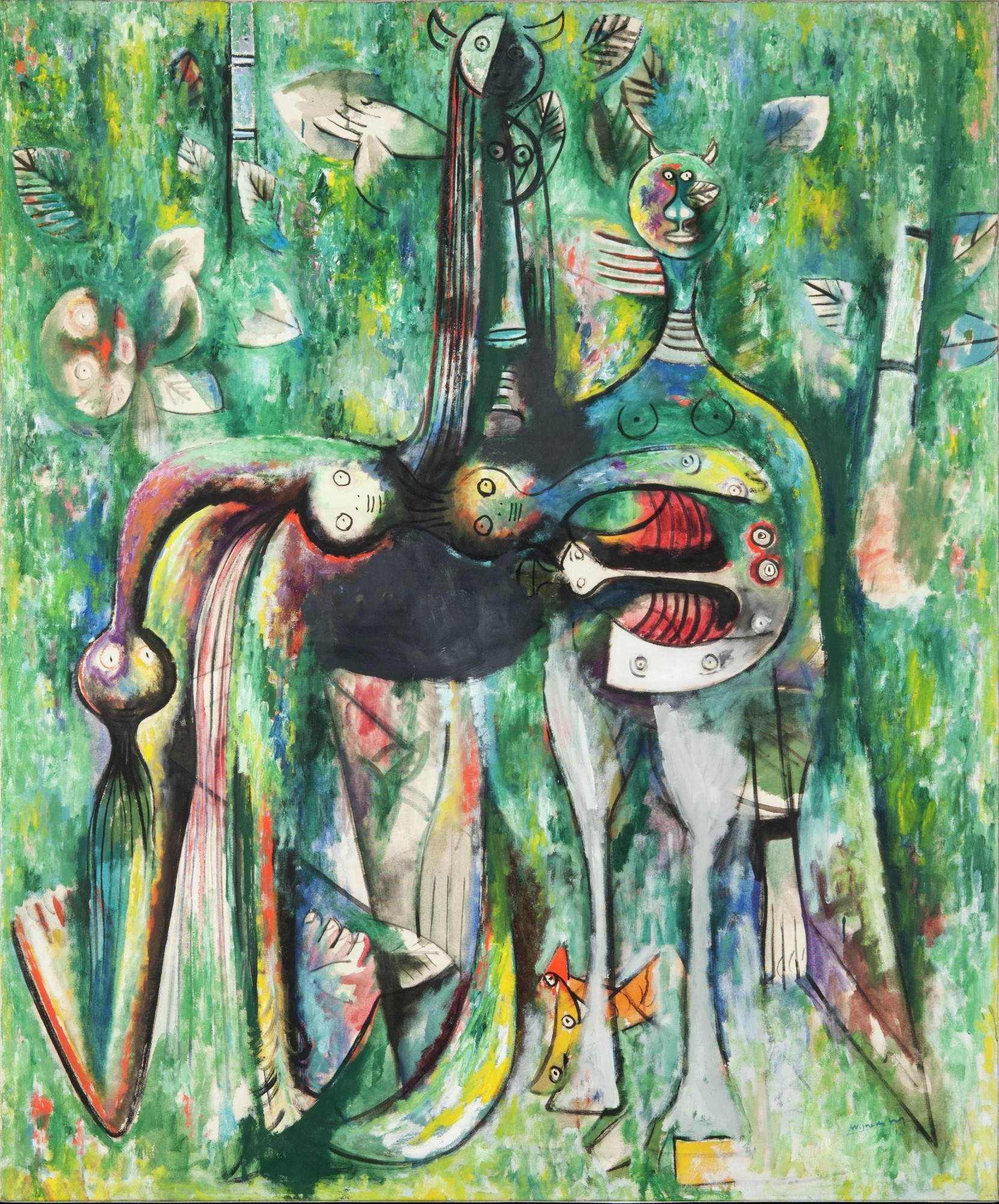
The Artist’s Son, Eskil Lam: During Wifredo's upbringing, he would hear the sound of drums that would come from the other side of the river, and these were where mostly Black people would live, descendants of slaves, and they had rituals called Santería, and he starts to include that in his painting.
Narrator, Marlin Ramos: Anthropologist, Martin Tsang.
Anthropologist, Martin Tsang: Afro-Cuban religions include Lucumí, or Santería, from the Yoruba-speaking people of southwestern Nigeria, which is the worship of the orishas, or spirits. We also have Palo, from Central Africa, Benin practices called Arará, as well as European or Christian ideas.
Marlin Ramos: The title of this painting, Somber Malembo, God of the Crossroads, references the orisha from the tradition of Lucumí or Santería.
Martin Tsang: You see within much of Lam's work what could be identified as an Eleguá-type figure—this small, domed head. Eleguá is the orisha of the crossroads. He has the sole ability to open doors, to communicate across languages, and to bring both good fortune and to stave away bad luck.
Ecologist, Leo R. Douglas: A crossroad means there are multiple ways forward. It's a point of departure.
Marlin Ramos: The word “Malembo” in the title may refer to a slave port on the west coast of Africa. By the time Lam was born in 1902, it had only been 16 years since slavery had been abolished in Cuba.
Leo R. Douglas: The point of departure of Africans would've been etched in their memory forever, so the worship of Afro-Caribbean people was about connecting to their homeland. It was about connecting to their ancestors. It was about being in communion with those who they did not have with them.
Artist, María Magdalena Campos-Pons: So the separation of the point of departure from the continent to the island is not vast. It's very present. Those references to Africa and to memory and history, in his case, is not even memory and history yet.