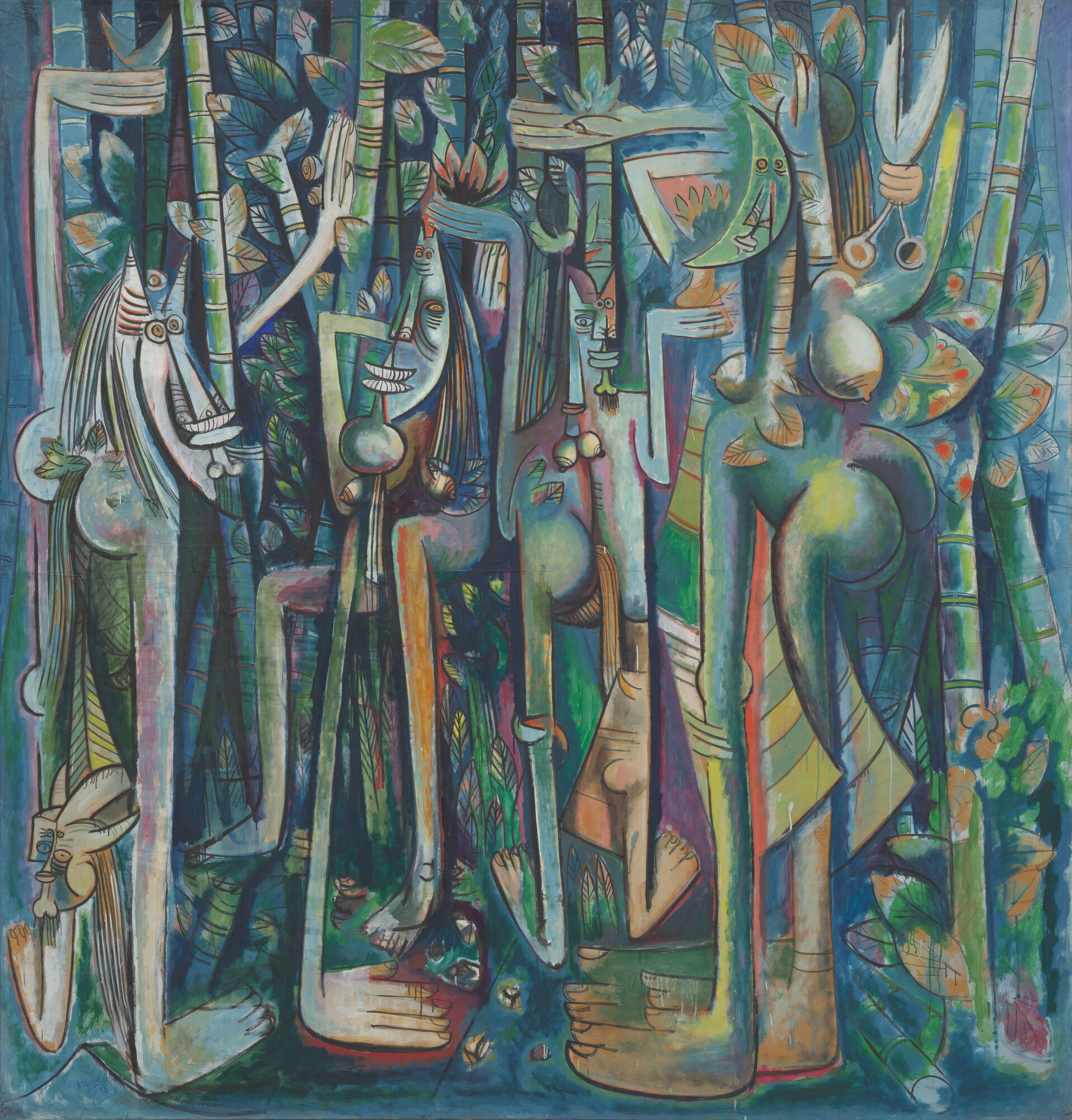
Narrator, Marlin Ramos: For many people, myself included, La Jungla, or, The Jungle, is the first work that comes to mind when you think of Wifredo Lam. It was painted following his first year back in Cuba.
The Artist’s Son, Eskil Lam: He's been gone for almost 18 years. And it's a very harsh return. He has zero money, but he's welcomed by his family, and then it's a new chapter that starts. And of course, his political awareness has been awakened, and he says his famous phrase: "I wanted with all my heart to paint the drama of my country."
Marlin Ramos: Lam began a series of works with human-animal hybrids within a distinctly Caribbean landscape. Centuries of history collide in this work. Historian, Ada Ferrer:
Historian, Ada Ferrer: It's full of these tall stalks of sugar cane. The figures are African, and most Africans who were forcibly transported to Cuba were destined for the sugar plantations that made Cuba the world's largest producer of sugar for much of the 19th century and beyond.
There's one figure that seems to be so bent over that her hands are reaching the ground near her feet, and that figure always makes me think about the backbreaking work of the sugar harvest.
There's a landscape that is dense and rich, and sometimes hard to distinguish what's happening. So I think of that almost as if the figures are hiding, or as if they're seeking, maybe finding, a space of refuge, an escape, maybe even a space of joy. So, to me, it captures something of the struggle for freedom.