Historian, Tressie McMillan Cottom: It is important to me that everybody listening to this know that I was the first girl in my high school to get acrylic tips. I want that on the record. Is that now official? [Chuckles]
I am Tressie McMillan Cottom. I am a professor and I think a lot about race and class and gender through beauty and economics and culture.
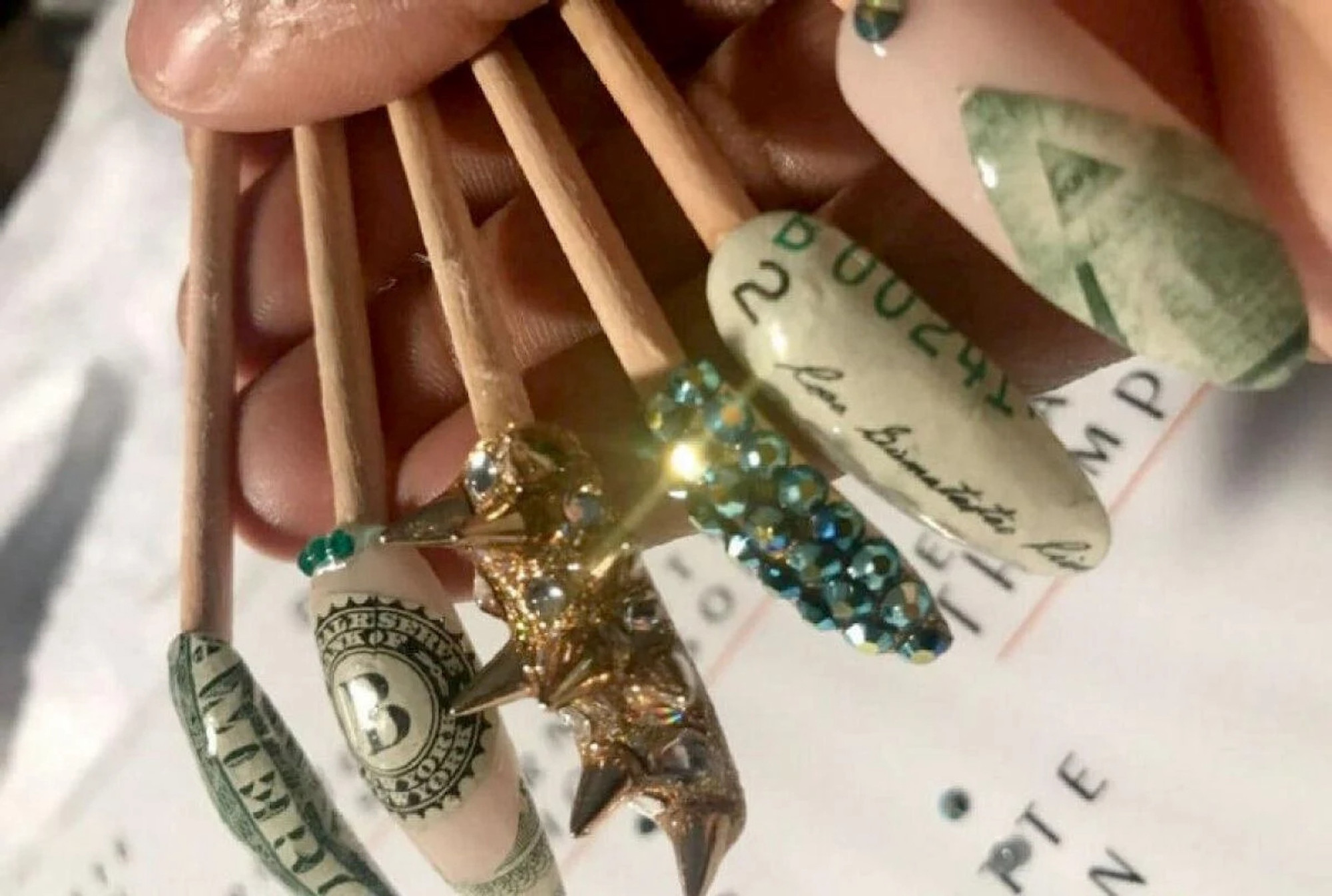
This is a set of acrylic nails designed for the hip-hop icon Lil’ Kim by Bernadette Thompson. She used elements from the American dollar on some of the nails. You also have some green rhinestones, gold, of course. I grew up during the golden age of hip-hop where nails were a big part of participating in what we, at the time, would call urban culture. I was so attracted to the performance of women rappers at that moment. Their aesthetic display of female power just really resonated with me.
Nail salons popped up in Black and Latino communities across the country, but also working class communities, where I think it opened up a space for artistic self-expression for people who are usually thought of as being the “wrong” class, the “wrong” race, the “wrong” nationality to do art.
But then I also think about how our hands are still a way that we say, “This is where I am in the class hierarchy.” Almost all women are expected to do some form of manicure, but to do it as a wealthy woman is still to do it in a way that minimizes individuality—neutral, pink, short, nothing pointy, and certainly nothing beyond a certain length. And then there's a range of color and artistry and length and shape that are associated with everybody else. And so I think we're also still fighting out those status distinctions in our nail art.
When it comes to beauty, I always hope that it will be a way for Black women to make choices on our own terms and to not have those decisions be used to further stigmatize or marginalize us.