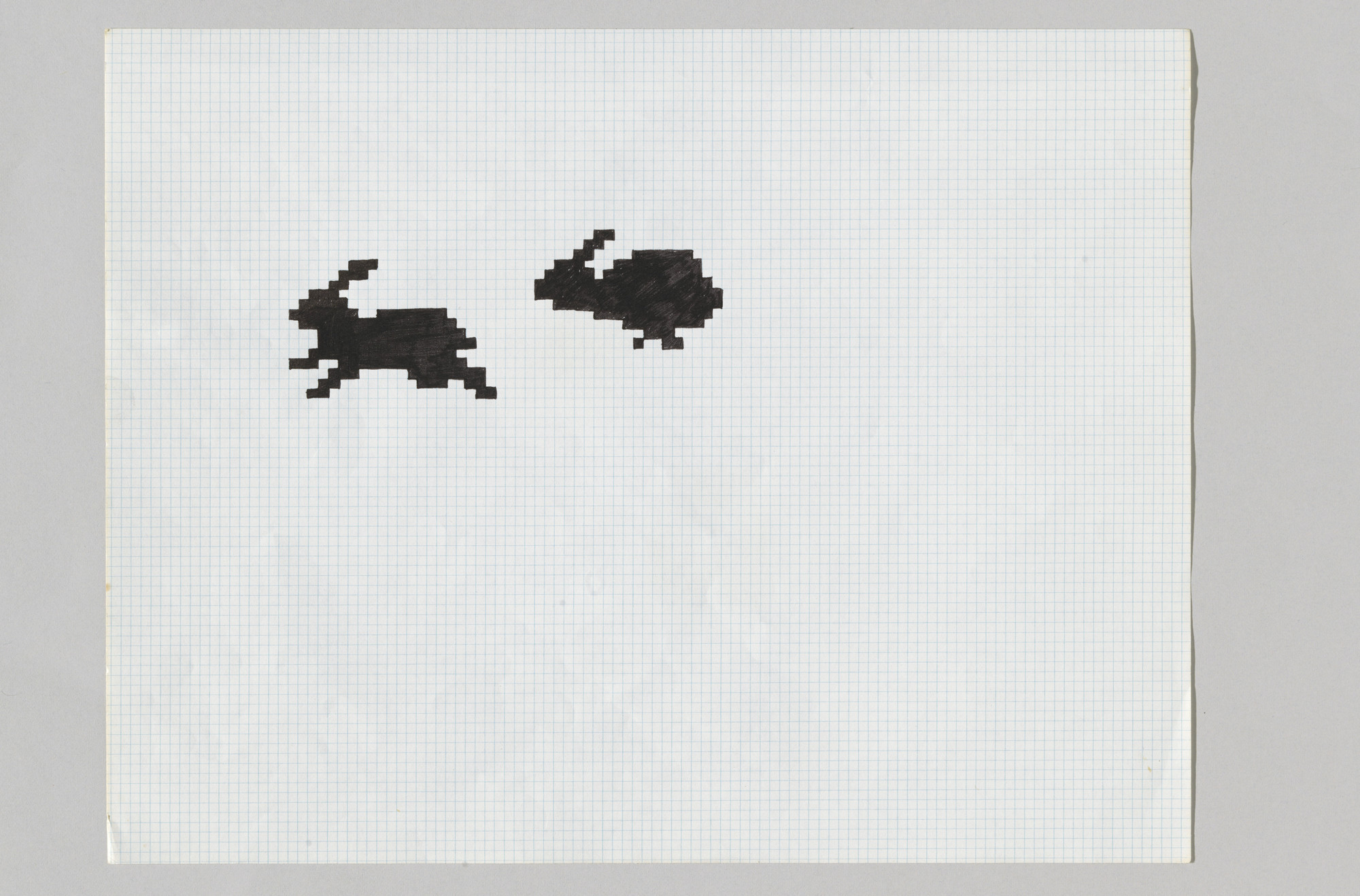
Designer, Susan Kare: Hi, my name is Susan Kare. I’m a graphic designer. I got my start working on the Macintosh computer—the first one—in the early ‘80s, for Apple.
Because I didn’t have a computer at the time, I was encouraged to get graph paper. And these notebooks contain my first thinking about, how do you create symbols using a small number of pixels? On the Macintosh, there were 32 pixels in about half an inch, so an icon was around a thousand pixels—quite a bit of freedom even in a small space with one color.
Before the command key was the cloverleaf that we recognize now, it was the Apple logo. But we were encouraged to find something else that would stand for command or feature.
At first, I thought about the ten commandments and police hats and badges and all the things that maybe symbolize a command, but they seemed too harsh. I was thumbing through a symbol dictionary, and I saw a four-leaf-clover-shaped symbol, and it said that it was used in Swedish campgrounds to denote an interesting feature if you were sightseeing. And I thought, “Oh, great! It’s abstract, but it’s kind of friendly and it’s really easy to express in pixels.” Apple ended up using it and still does on the keyboard and in the menus.
When I got to Apple, there was a tremendous focus on designing the Macintosh, so that it would be, as the ad said, “the computer for the rest of us.” And a big part of that was using visual design to communicate. You didn’t have to have specialized knowledge. Little pictures and symbols made that computer accessible.