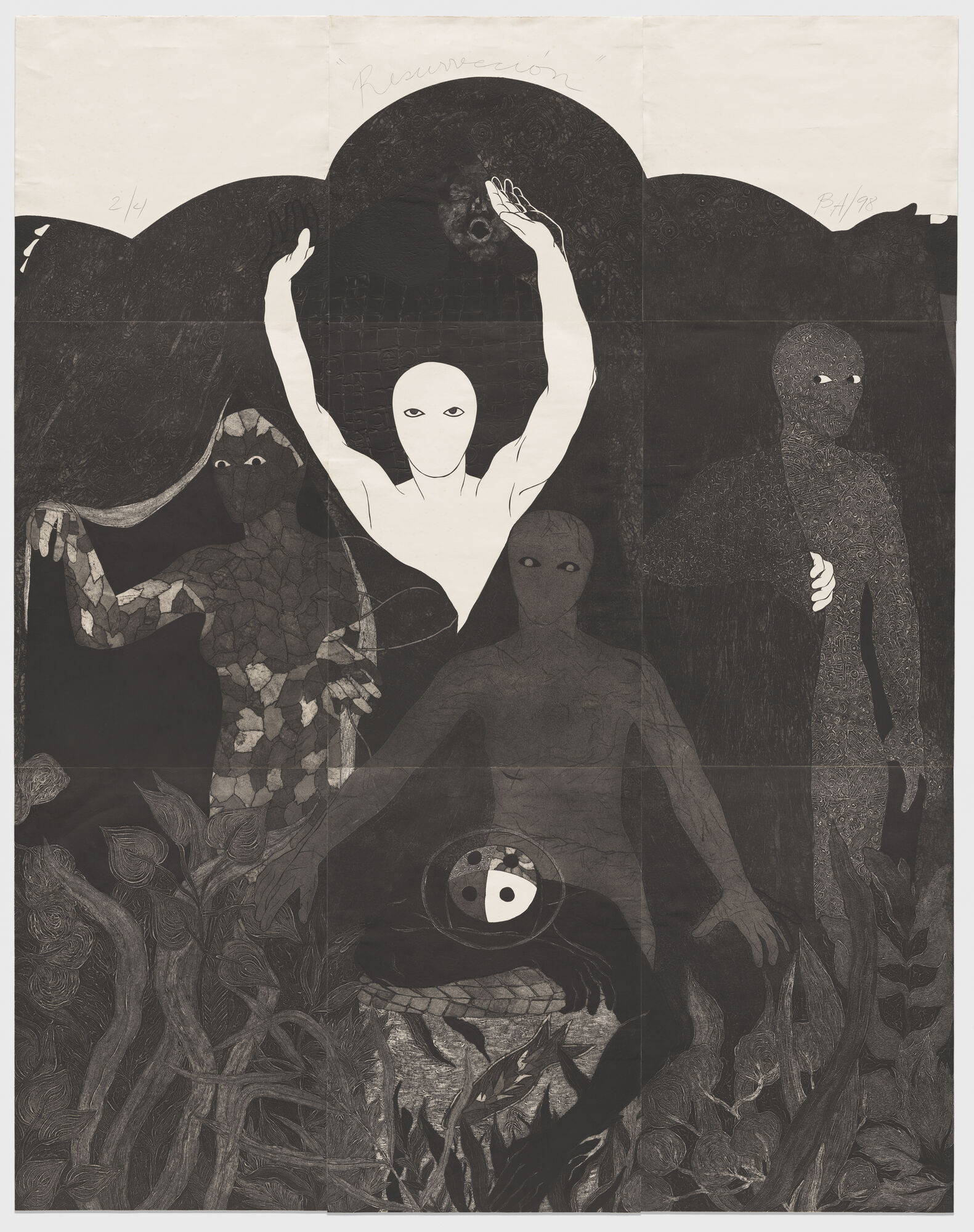
Artist, Tiona Nekkia McClodden: My name is Tiona Nekkia McClodden and I’m an artist. And Belkis Ayón is my greatest influence.
Belkis is from Cuba and started to investigate Afro-Cuban religion practices. So she looked into the Abakuá. This is a very small sect of practitioners. It’s all men, no women can join. But one of the core figures at the center of this mythology is a woman.
It’s the story of Sikán. She is going to the river to get water, coming across this special fish that has this beautiful voice that the Abakuá have always wanted to capture. Unknowingly, the fish slips into the jug that she’s trying to carry. The Abakuá try to capture the jug, the fish escapes, dies, and they assume that she has the voice by proximity. They sacrifice her and her skin becomes the skin of the drum that they invoke to keep her voice to themselves.
This image contains this search that the Abakuá have embarked on to try to seek this voice. The center figure, at the top, has a mouth and can speak. It seems to be in a shadow of blackness, casting a veil on these different figures. None of them have mouths, so they are without a voice. I like the idea of this voice as the veil.
These figures can exhibit feminine and masculine traits. I think that there’s a space where women have had to abstract and transfigure themselves to be able to survive and I think that Belkis twists and bends the image in thinking about that. She is not afraid to complicate the ideas and notions of gender within something that is strictly thought of as male.