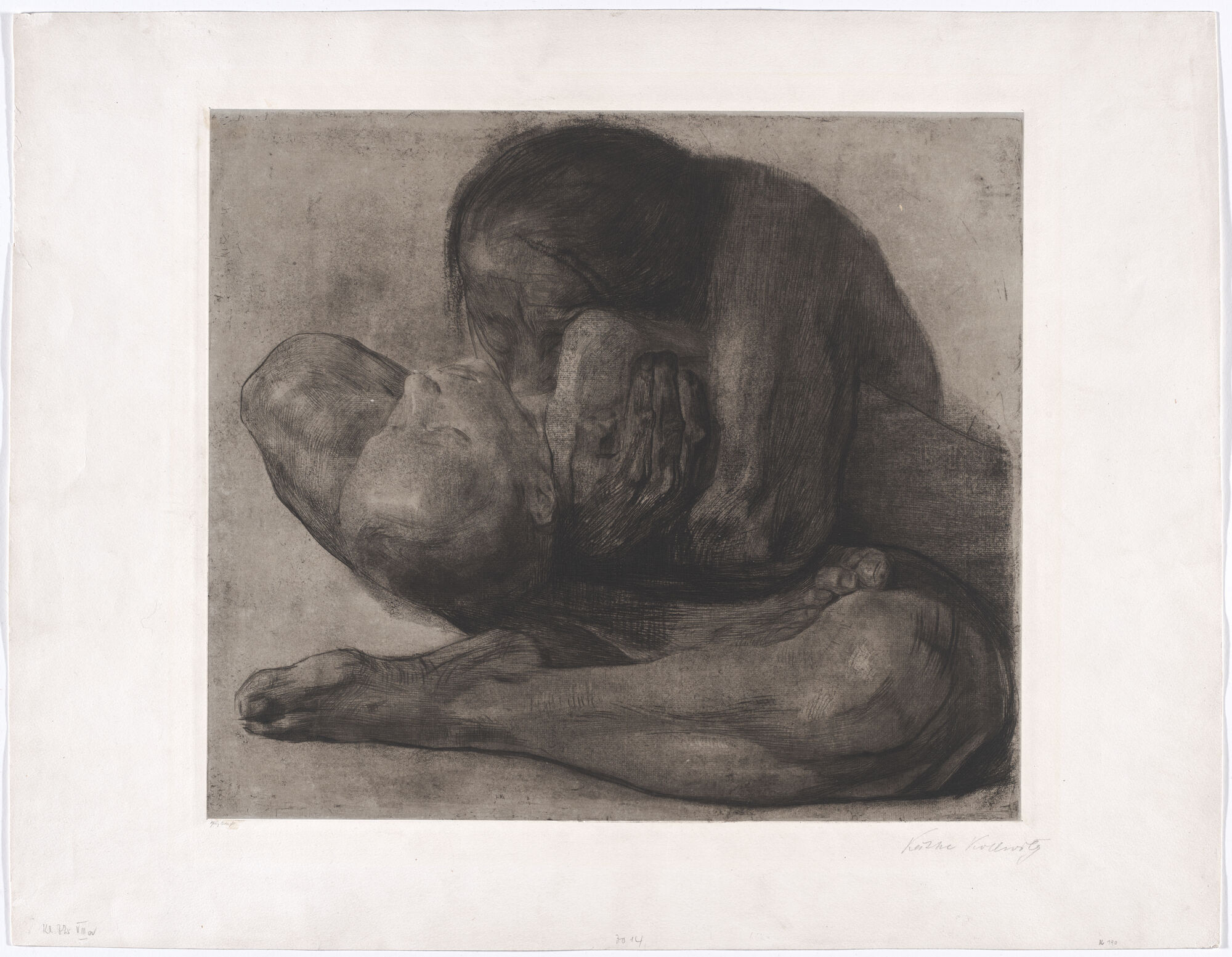
Printmaker, Rob Swainston: Woman with Dead Child—that’s a tough image. Käthe Kollwitz’s husband was a doctor, who was very active in helping the poor. And she's keeping a studio adjacent to her husband’s medical practice, she’s seeing something like this every day.
I’m Rob Swainston. I’m an artist. I’m a printmaker in New York City.
As a printmaker, you go back in and you keep reworking something until you figure out the best way, technically, to achieve what you want—these are called the states of an image. My suspicion would be that she printed a number of impressions of it and probably had them hanging on her wall to see: “What would it be like if it had a background? Does the blue work better? Does the gold work better?”
Curator, Starr Figura: If you read her diaries, she’s just constantly doubting her ability to get something the way she wants it to be, and so you see that when you see all these versions of things, where she keeps tweaking it here and there and revising it this way and that way.
Rob Swainston: For her to return to this image again and again, it’s a space of contemplation. By the time she makes it to the final, she's gotten rid of the ground and it’s just the figure, which makes it even more powerful. The simplicity of it, it really forces you to look at the central subject matter.
Starr Figura: She wants to take the emotion of her subjects and channel it through herself to the viewer. That’s what you see in the intensiveness of her process.