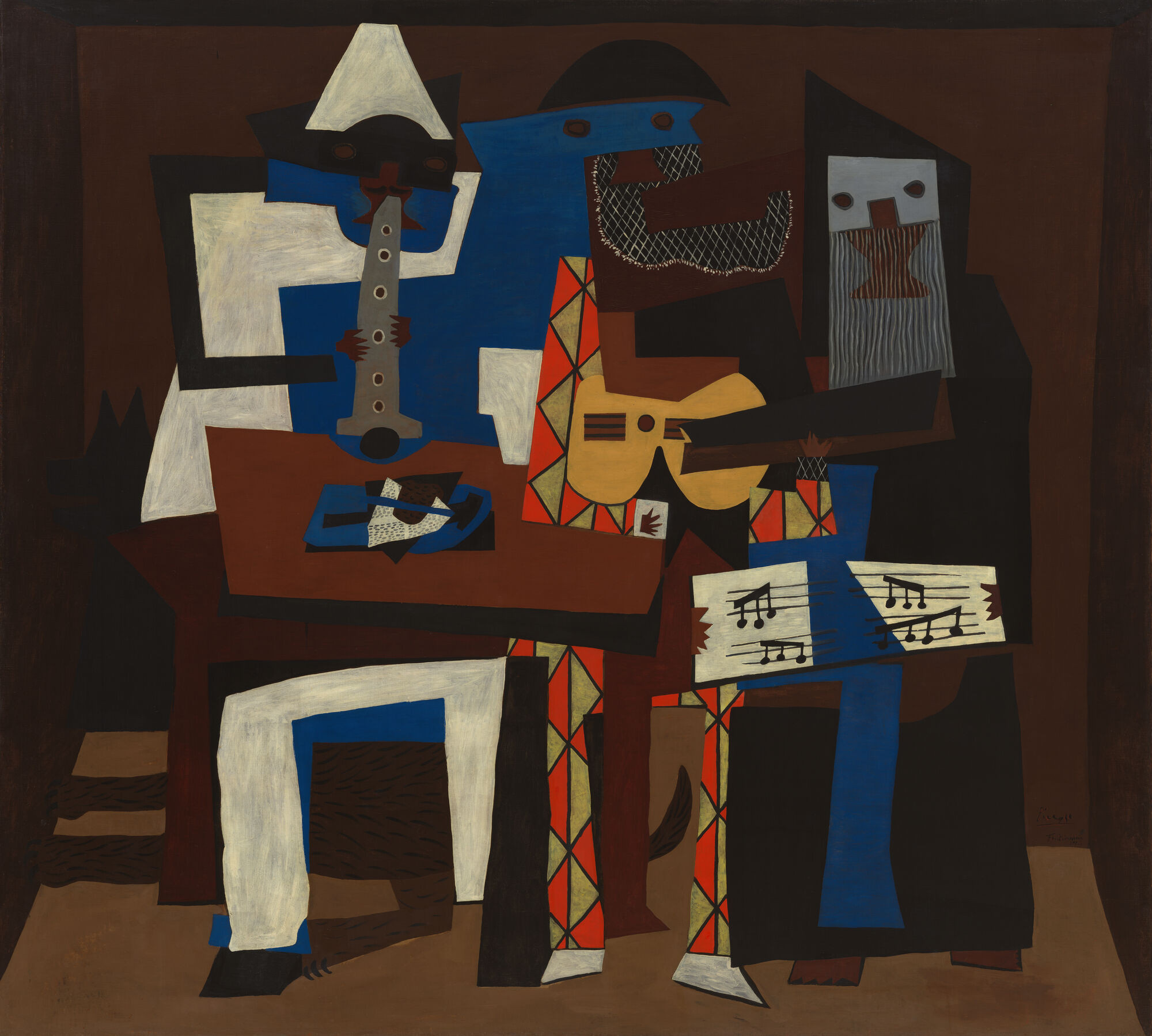
Curator, Anne Umland: We know from photographs that during his time in Fontainebleau, Picasso painted two mural-sized versions of the subject of three musicians. Each featured these very colorful, collage-like musicians seated behind a table in this shallow, stage-like space.
In the version of the picture that we’re facing, the leftmost figure can be identified as a commedia dell’arte character, known as Pierrot, who is known for his melancholy. Here he sits next to a Harlequin figure, known as a trickster. On the right is a monk, dressed in a very abstract version of a Benedictine robe.
But just pivot, what’s behind you? Three Musicians across the way.
You can go back and forth to identify both the similarities and the differences. In the version of the picture behind us, the Harlequin and the Pierrot figures have switched places. They’ve switched instruments. And the monk wears a brown Franciscan robe as opposed to the black Benedictine one.
Picasso designed the sets and the costumes for two ballets performed in Paris in the six months or so before he leaves on vacation. And so notions of performance and stage and scale, working big—those are all things that must have been on his mind.
Theater Director, Patricia McGregor: Three Musicians feels very theatrical. They’re in masks. Their costumes feel very intentional, very bold. These tiny little hands, these jagged fingers attached to these instruments, just vividly makes me think of the music that is being played.
Anne Umland: The two Three Musician canvases and the Three Women at the Spring canvases are facing each other across the room in the way that they were positioned in the Fontainebleau studio.
Patricia McGregor: With Three Women at the Spring, none of them are looking directly at me. It feels like they are being observed. We are getting to glimpse into their world. Even though they are together, it feels they are not connected, they are not in concert with each other.
Whereas with the Three Musicians, they are playing to us. We call that breaking the fourth wall. It feels like they are there to burst into our world. It feels like jazz. It feels like, you play that note, I play this note, and together the collective is bigger than the individual.