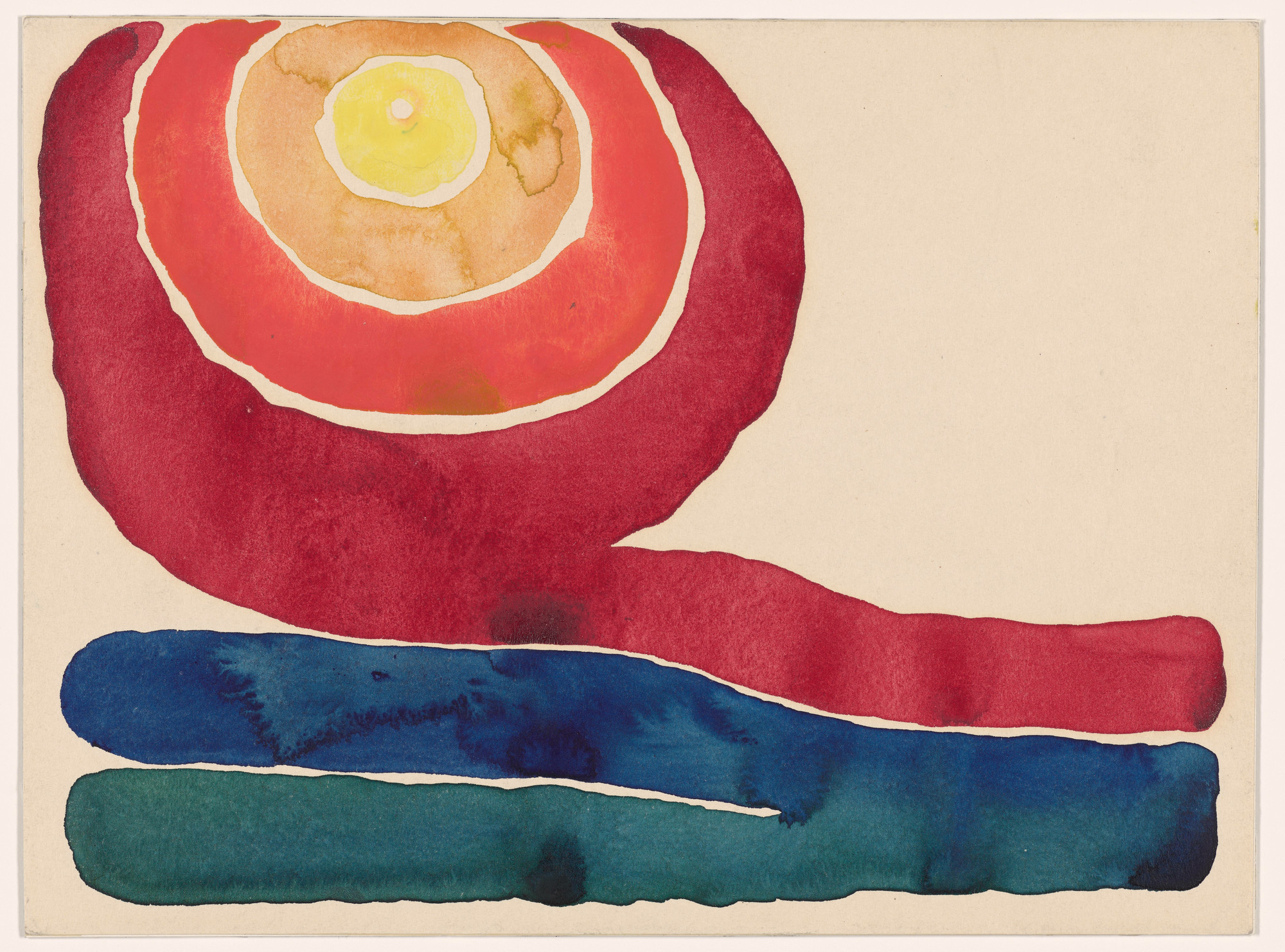
Curator, Samantha Friedman: We’re looking at O’Keeffe’s Evening Star series of watercolors in which she traced the phenomenon of a Texas sunset. She wrote to her friend, Anita Pollitzer:
Actor (Georgia O’Keeffe): The sky, Anita, you have never seen a sky like this.
Samantha Friedman: And you can see that sense of awe and wonder translated in her shift to a much bolder palette.
And one of the things that’s really interesting about this series is that it’s so explicitly numbered. We have a beginning, we have an end, and therefore we have a story. It unfolds over time.
Conservator, Laura Neufeld: The first work is a much more traditional landscape. You understand it as ground and sky. And then the colors start to condense into abstract concentric rings, with razor thin reserves of white paper that create this real tension in the composition.
And then that starts to break down and you see colors flood into each other. That paper doesn’t absorb the pigment right away and that’s why you get these deep puddles of rich color.
The colors blend together more and more, until you reach the final composition, where what she’s interested in is how far you can push blending them together, which is accomplished by changing the paper and using this incredibly absorbent Japanese paper. The paint just soaks immediately into it so that you get these soft transitions of diffuse color, creating that ethereal effect.