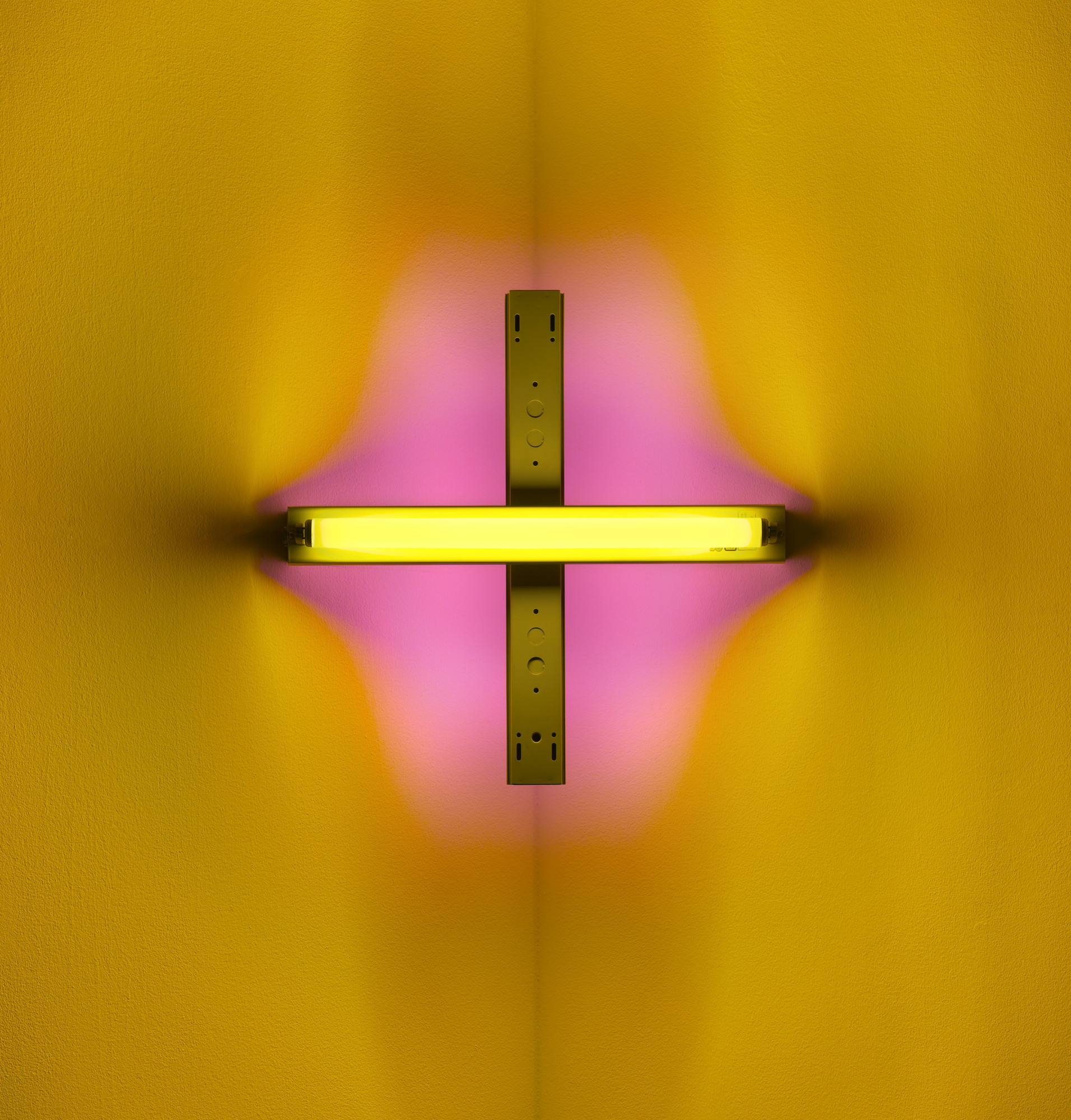
Artist, Dan Flavin: All throughout the history of art is [an] expectation about light. I see myself as an artist of the light media directly.
Narrator: That's the artist Dan Flavin. After years of drawing and experimenting with found materials, Flavin began working with light.
Dan Flavin: I didn't see it as a break. I saw it as part of a continuity. The extension of that was to take another typical object. And so I decided that there were two light sources that were typical: the fluorescent, which was modern, and the incandescent light bulb, which had its long history back to Edison. And that's how it began.
I think I always understood that it was architecturally related, and this is what I always referred to as situational. The first thing you notice is that there is a dramatic quality of placing the lamp and getting a return on the light from where you put it, and the shadow cast by the supporting equipment. And the next challenge is to do something with it, to assemble systems. And so I decided to make squares that spanned the corner.
We had a system of forelighting and backlighting to define the corner or not, and I found that opposite light would project to opposite walls. In other words, the light would pass through the other light source and still come out clearly on the opposite wall. I found that a very interesting area to operate in—to take part of the corner and use it as a field of play.
But they met with some resistance. They were new to me, too, as they were new to other people.
> Archival audio from: Interview with Dan Flavin by Louise Averill Svensen, August 21, 1975, Solomon R. Guggenheim Museum Archives Repository