Artist, Anne Truitt: People talk as if art was something that you did with your eyes and your brain, but it's not. It's something that grows out of a ground.
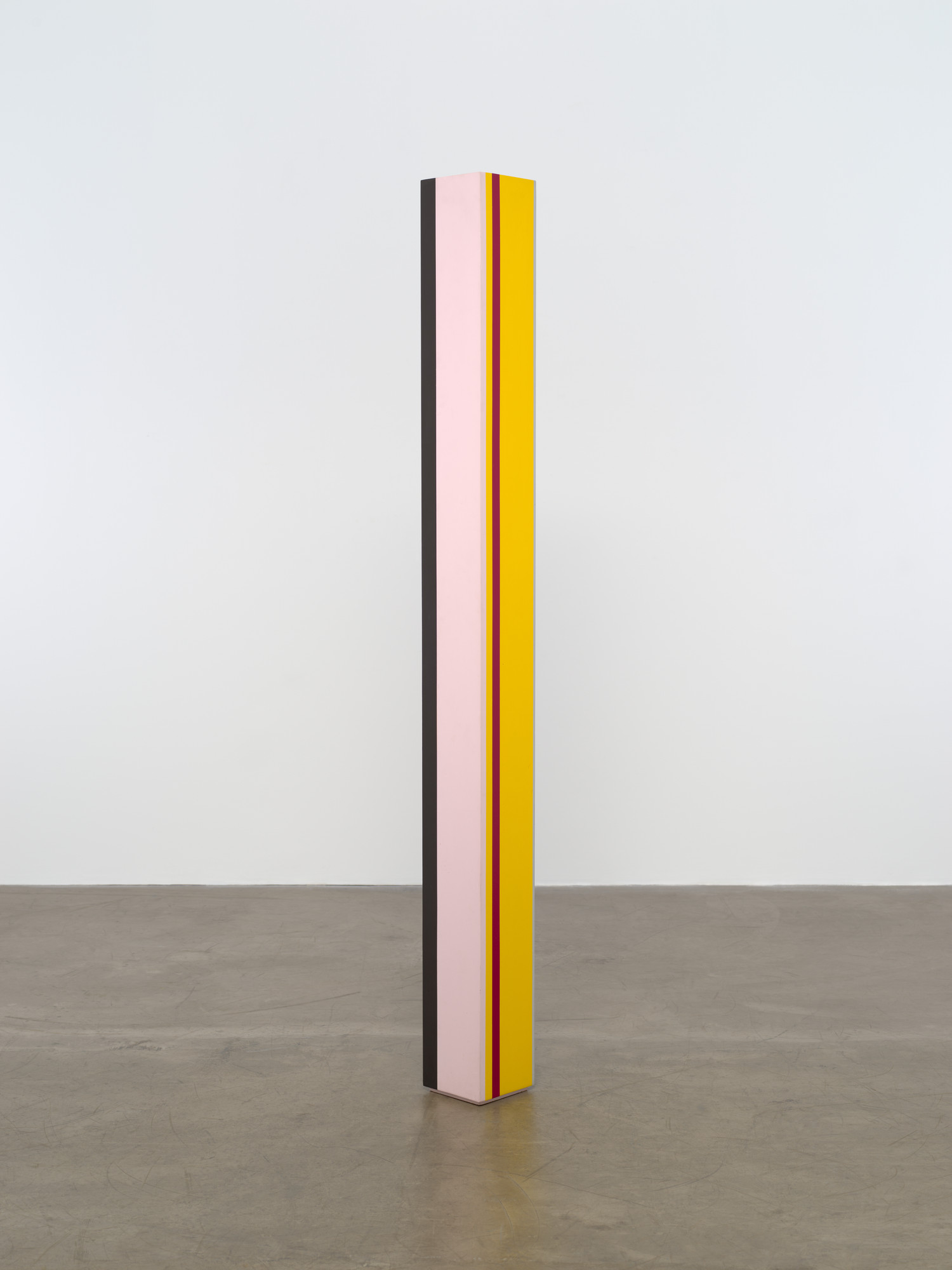
Art Historian, Erica DiBenedetto: That was the artist Anne Truitt. Truitt is best known for her colorful and labor-intensive sculptures. She preferred working with wood and alternated between painting and sanding the surface to create a smooth finish. She also balanced her sculptures on recessed bases, so they appear to be hovering.
Anne Truitt: The line of gravity in the center of my sculptures is really the essence. Around the line of gravity, I can magnetize the color, the meaning of the sculpture. Just in the same way that along the line of gravity in our bodies, our lives are organized. Without that line of gravity, you haven't got anything. We wouldn't be here. Nothing would be able to stand up.
Erica DiBenedetto: Truitt came to art when she was in her forties and had already made a career out of writing and translating.
Anne Truitt: I was struggling with writing, and what I was struggling with was time. And I thought to myself, if I make a sculpture, it'll just stand up straight, and the seasons will go around it, and the light will go around it, and it will record time.
Erica DiBenedetto: Truitt was frustrated with the idea that everything had to have a beginning, middle, and end, or a sense of a linear order. And so here, we have a work where it's hard to tell where it begins and where it ends. The sculpture really invites us to move around it and see how it changes with each passing second.
I think this also speaks to how Truitt understood color, which for her was a way to convey memories as well as impressions and sensations.
Anne Truitt: Everything in my experience goes into my work because that kind of understanding that stains your body, stains your being, the way color stains cloth, I just distill my work out of it.
Archival audio from: Oral history interview with Anne Truitt, 2002 April-August. Archives of American Art, Smithsonian Institution.