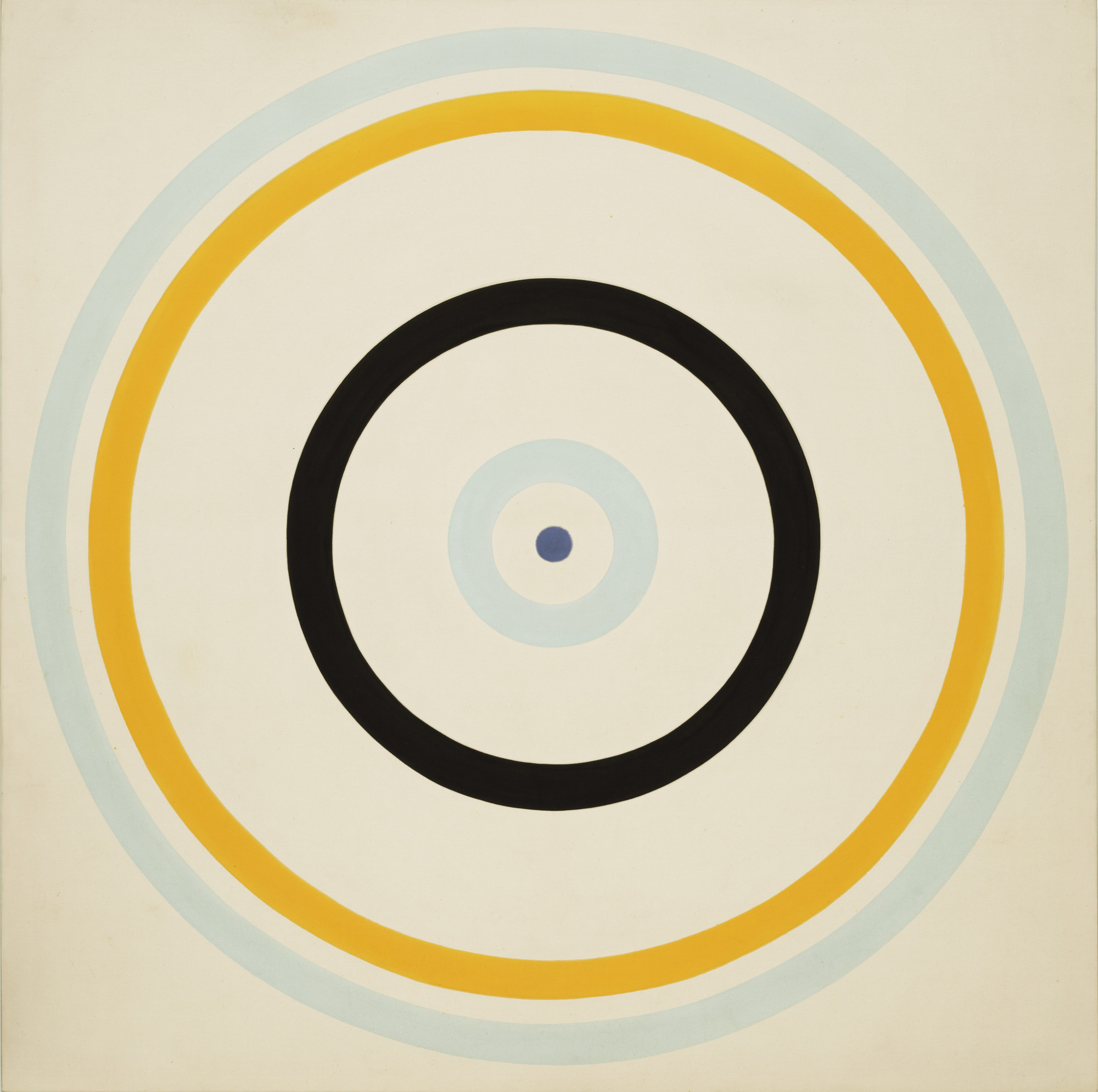
Artist, Kenneth Noland: Color has pulses, and those pulses can lead you from one dimension to another dimension.
Art Historian, Erica DiBenedetto: My name is Erica DiBenedetto, and I am an art historian.
We are standing in front of one of Kenneth Noland's circle paintings called Turnsole. Noland painted it on unprimed canvas, meaning that the canvas hasn't been treated to stop the paint from soaking into it. So, the circle’s outer boundary slightly bleeds into the canvas.
Noland is not interested in making himself physically present in the composition. And so staining was one way of making a painting as flat as possible.
Kenneth Noland: I've gotten very interested in seeing different depths of colors, that exist simultaneously. A stain painting can cause you to follow a color into another color, to another color by the difference of transparency, of warmth, coolness.
Erica DiBenedetto: So he is thinking about the optical effects of color in abstraction. The stained surface absorbs light in a different way than the painted surface, which impacts the way we're seeing color.
Archival audio from: Oral history interview with Kenneth Noland, 1987 July 1-16. Archives of American Art, Smithsonian Institution.