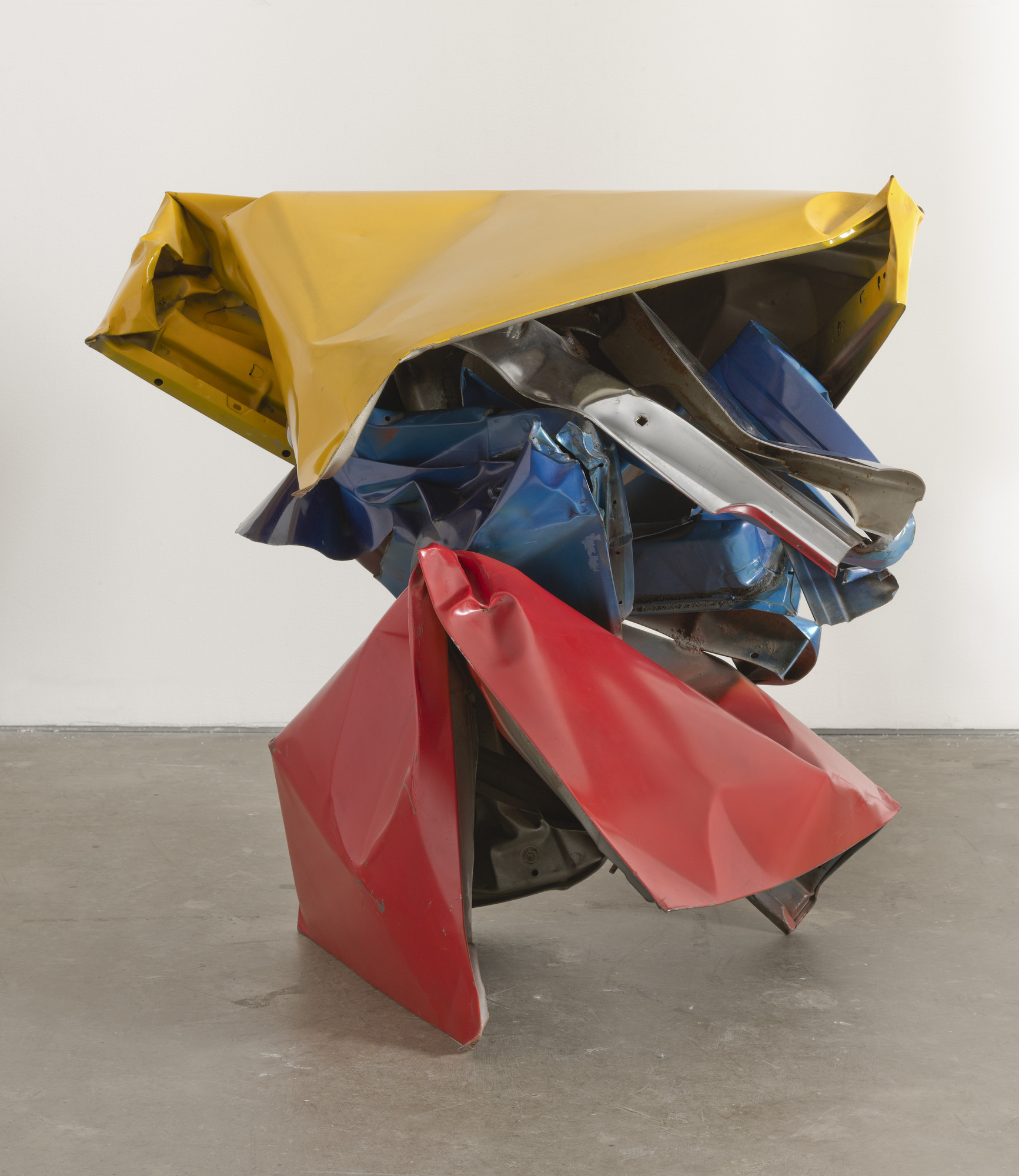
Artist, John Chamberlain: If you go in the bathroom and you throw your towels or you look at your bed and it's all crumpled up, they don't look unlike my work.
Narrator: That's the artist John Chamberlain. He often made his twisted and tangled sculptures out of discarded car parts—cutting, bending, crushing, fitting, and welding the metal pieces together.
John Chamberlain: I don't know what other artists do, but they don't all work intuitively. You have this material. What do I do with this material? Sometimes, I'll pick up something and take it over here, and it fits. And then the color—by the time it gets done being screwed around with, half of it is peeled off. You do things until they're played out. After they're played out, you shift it a little and you get a different viewpoint.
Art is the only place left where a person can go discover something and not have to be told by somebody else whether they discovered it or not. Because anything they come up with is okay at the time. I mean, I'm just as interested in somebody who just violently hates my work as I am in somebody who likes it, because it's better to be bothered and to find your way through it. If you go look at it again, you've grown, so it becomes different. That's what abstraction does. That's why I like it.
Archival audio from: Oral history interview with John Chamberlain, 1991 January 29-30. Archives of American Art, Smithsonian Institution.