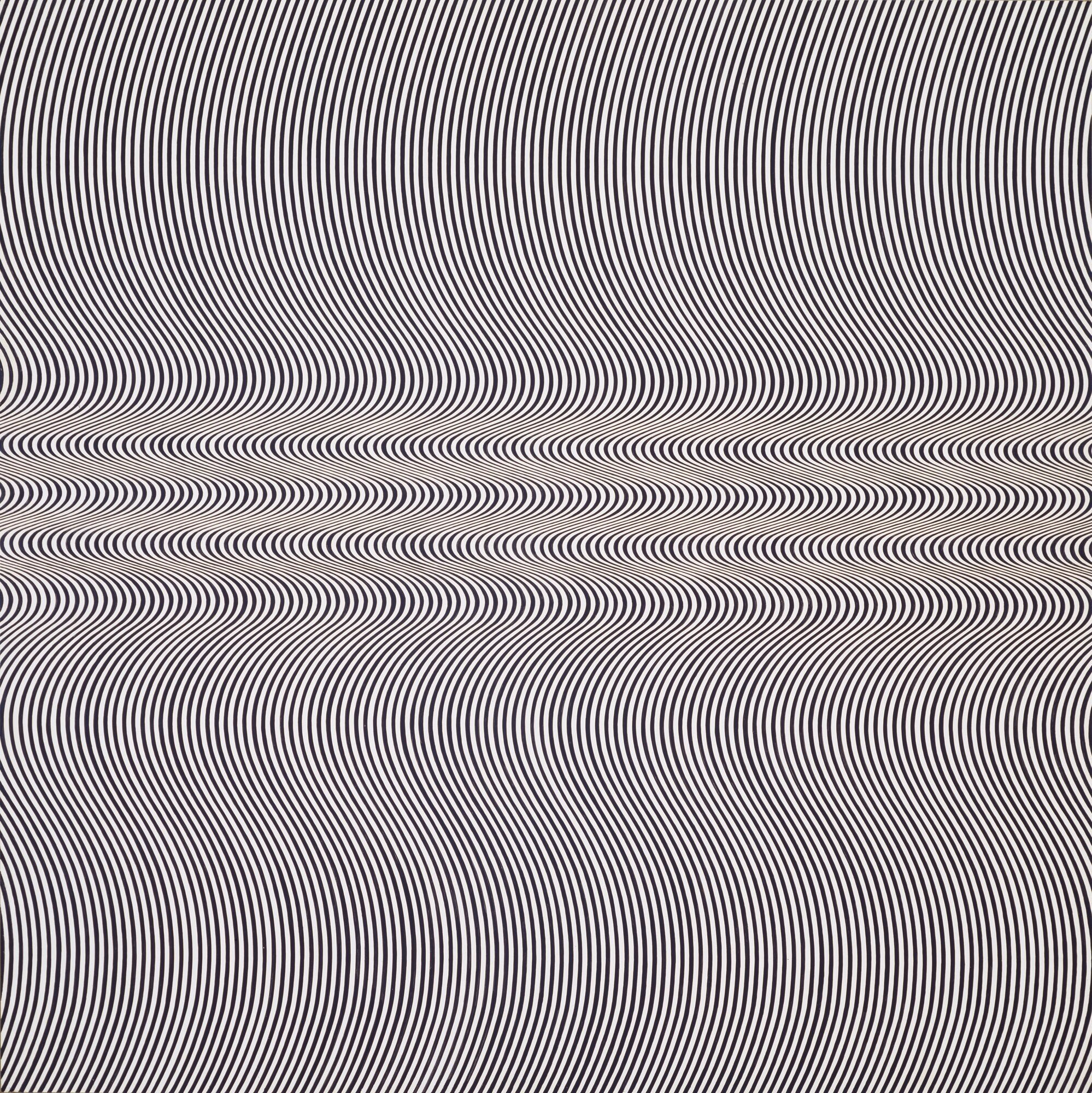
Narrator: As an art student in England during the 1940s and ‘50s, Bridget Riley received a traditional art education; she learned how to paint landscapes and figures. But in the 1960s, she began moving in a completely new direction.
Artist, Bridget Riley: I tried to struggle with what to paint and how to paint it. Well then, a man teaching in the north of England started to actually teach modern art. He held a whole lot of classes, and they absolutely exploded my mind.
I painted a totally black painting. And then I started just to push things about— blacks and whites and precise forms. And gradually, I saw incredible things beginning to happen in front of me. I realized that actually, the energies latent in the medium were enormous.
Narrator: In 1965, this painting by Riley was included in an exhibition at MoMA called The Responsive Eye. It featured artists who were using pattern and color to create optical effects. The style became known as Op Art, and the exhibition—it generated a lot of mixed feelings.
Bridget Riley: I was accused of eye-bashing, of aggressiveness. I was astounded. My medium is colors, forms, space, and surface. I'm trying to release the inherent characteristics of the medium, to allow them to speak freely.
Archival audio from: Bridget Riley and John Jonas Gruen. Interview with Bridget Riley, 1978 May 10. John Gruen and Jane Wilson papers, 1909-2016. Archives of American Art, Smithsonian Institution.