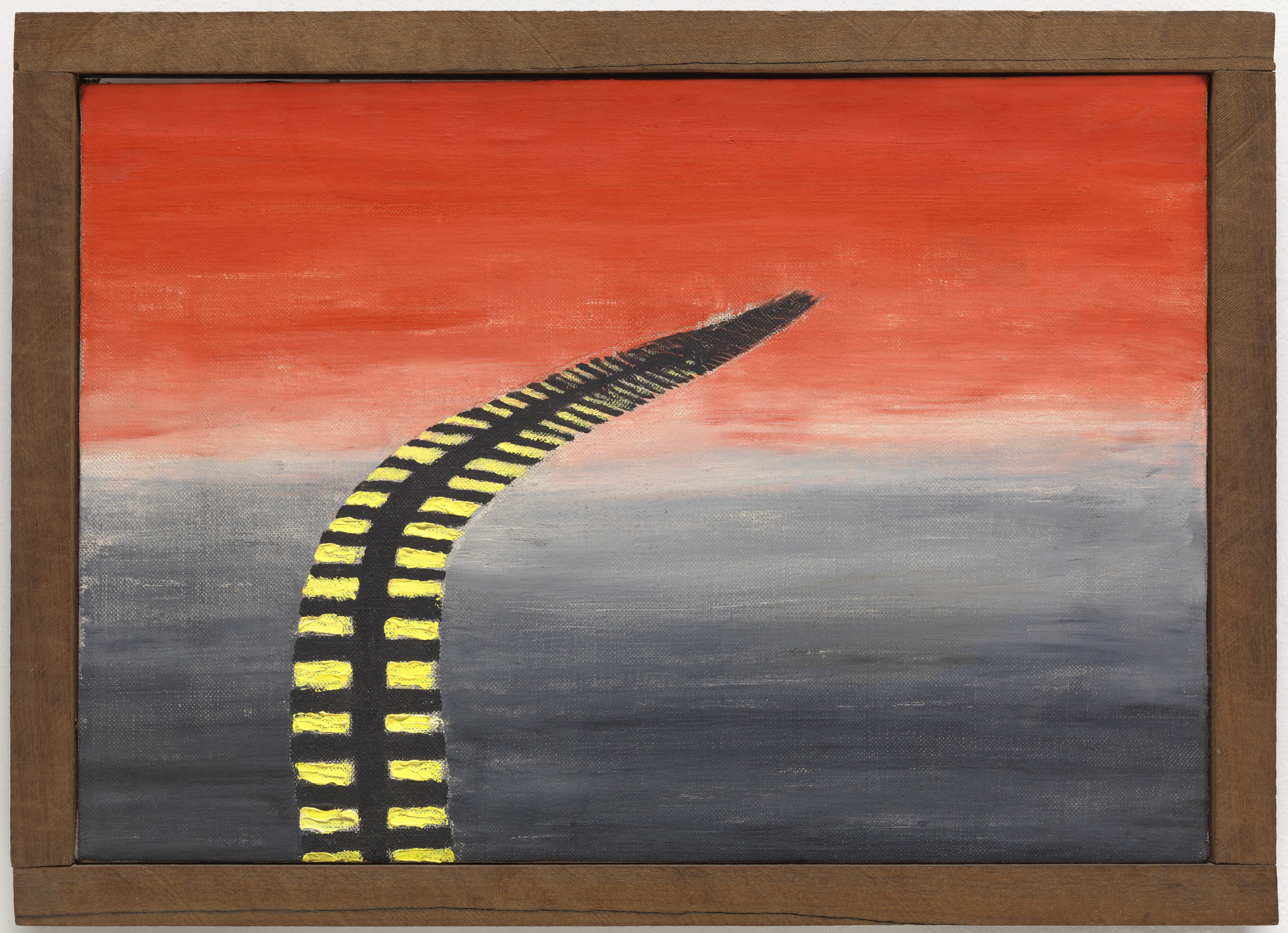
Art Historian, Cyle Metzger: Abstraction was the strategy for Bess to make himself visible in a world that didn't wanna see him.
My name is Cyle Metzger, and I’m an art historian focusing in transgender history in American art.
Forrest Bess was invested in the dissolution of boundaries between male and female genders. He had visions that he would translate into paintings and he was looking to the painting to reveal what was in his own mind.
In Bess’s system of symbolism he tended to describe red with male, white as female. So I see that red top half as this suggestion of masculinity that blends into femininity below it with that white, and then dropping into that gray is this allowance for mystery and spiritual transcendence.
Then this black and yellow tail-like shape—yellow is described as spiritual liberation, so there’s this kind of sense of a journey. The symbolism speaks, in my reading, to the liberation that he is after through the unification of male and female.
Signs of a person’s gender are in and of themselves arbitrary. They're made up to describe a certain pattern in the world. Abstraction in art is the use of arbitrary visual elements to represent an idea. And so for me, it started to feel very true that gender is a form of abstraction and that our gendered identity is formed via connections with others who use the same abstract signs to make themselves visible in the world.