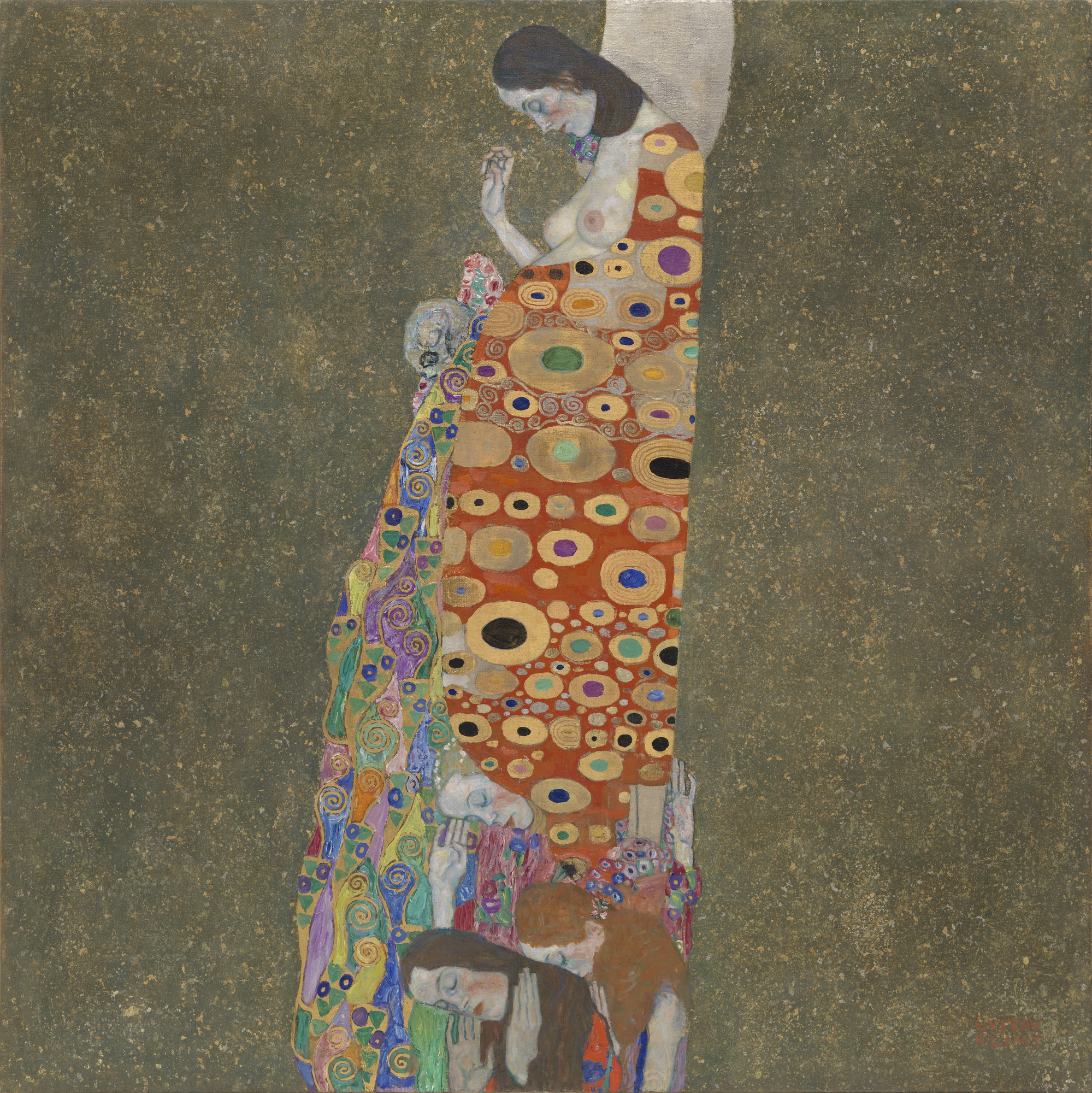
Art Historian, Andrea Achi: This is a painting by Gustav Klimt. It's called Hope, II. At its center is a pregnant woman. She's shrouded in this mosaic-like robe that glimmers with these circle patterns, spirals.
My name is Andrea Achi, and I'm a curator of Byzantine Art at the Metropolitan Museum of Art.
I can see Byzantine art in this work—with this gold, the use of ornamental patterns, but then also his deep interest in spiritual and symbolic content. The Byzantine Empire spans from the 4th to the 15th century in the Eastern Mediterranean. One of the most phenomenal representations of Byzantine art are the mosaics in Ravenna, Italy. We do know that Klimt went to Ravenna and was inspired by it.
What's fascinating about Byzantine mosaics specifically is that there's this intense use of gold. But then also these bright patterns with red and purple, greens and blues. When artists like Klimt were going to see these mosaics in person, they really felt the impact of the candlelight and the glittering aspect of the gold.
There's a sense of the importance of motherhood, both in Western medieval and in Byzantine art, through representation of pregnancy. And so you can really see Klimt continuing that here. The big question is, what aspect of motherhood are we seeing here?
You see a skull that appears to emerge from her belly. Does it represent mortality? You have these smaller figures at the bottom, are they mourning? Are they praying? Are they providing comfort to the pregnant woman?
You can tell that this is not a religious icon or painting in a traditional sense. Instead, it seems to be a modern meditation on perhaps womanhood, transformation, even the mystery of existence.