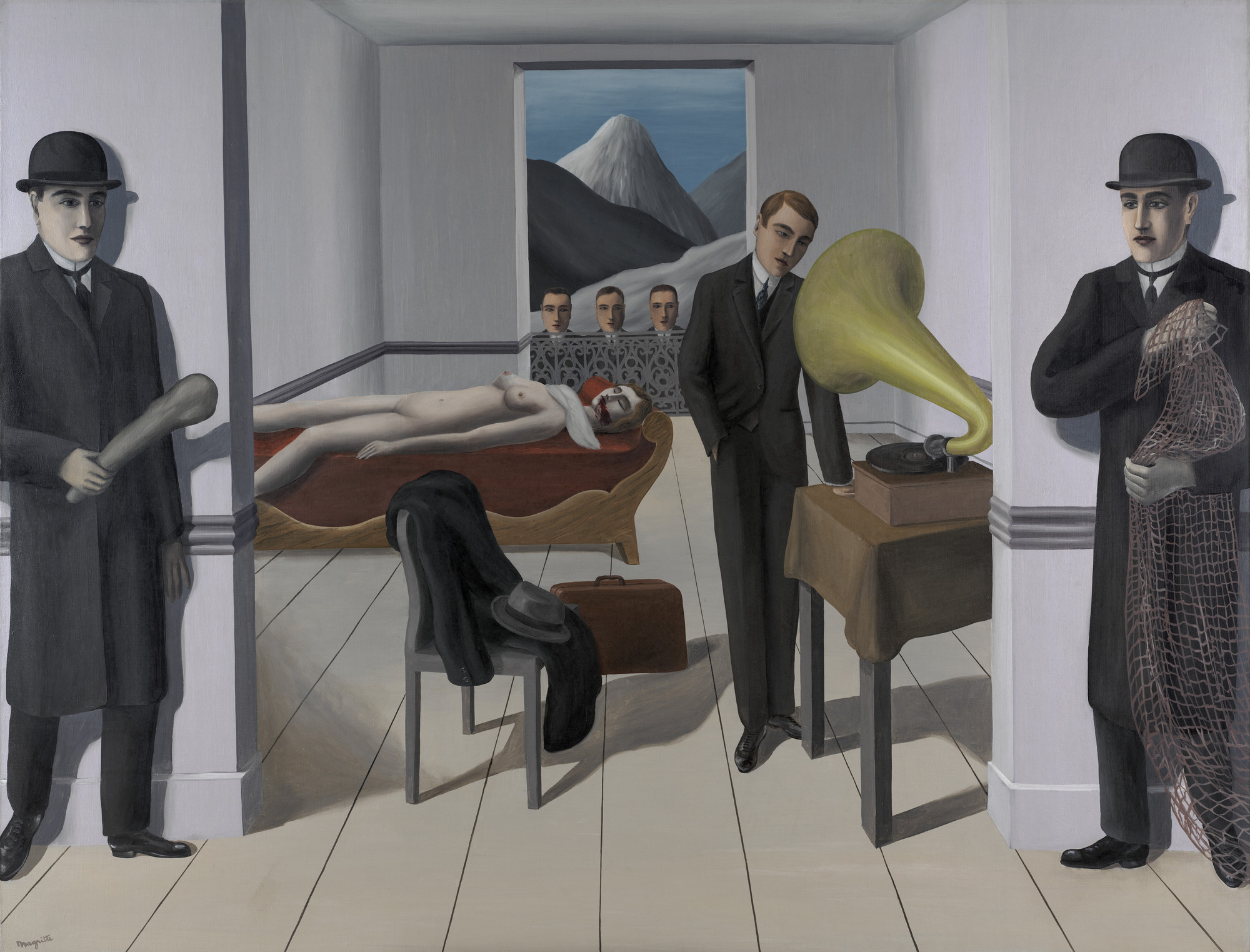
Curator, Anne Umland: What he presents us with is this mystery that will never be solved.
You see a space that is in fact comprised of three distinct parts. Sort of a perspective from a foyer outside, within which two bowler-hatted, impassive men lurk—one with a cudgel in his hand on the left, and the other with a net. And then as you enter into this deep space with its peculiarly tilting floor, your eye drawn into the center, you encounter the figure on the right: of another suited man apparently listening to music on an old fashioned phonograph, oblivious so it seems, to what lies behind him.
Narrator: Many surrealists, including Magritte, were fans of crime and detective stories of the era. This painting refers to a scene from a silent film adaptation of a crime novel in the popular series: Fantômas.
Anne Umland: And so it's another way of thinking about the Magee's ambition to create an immersive world, a kin in some way to cinema and to thinking of the canvas as a projection screen for these fantastical narratives and mysterious sceneS.
Narrator: Another way Magritte creates this immersive world is through his use of lines.
Conservator, Michael Duffy: We examined the painting with x-ray imagery, and it does seem like it was painted very quickly with these broad horizontal brush strokes in the foreground and broad vertical brushstrokes in the background. Details like the lines in the floorboard don't actually converge on a vanishing point. So he's not strictly adhering to a certain perspective. He's twisting it in a way that I think makes it more interesting.