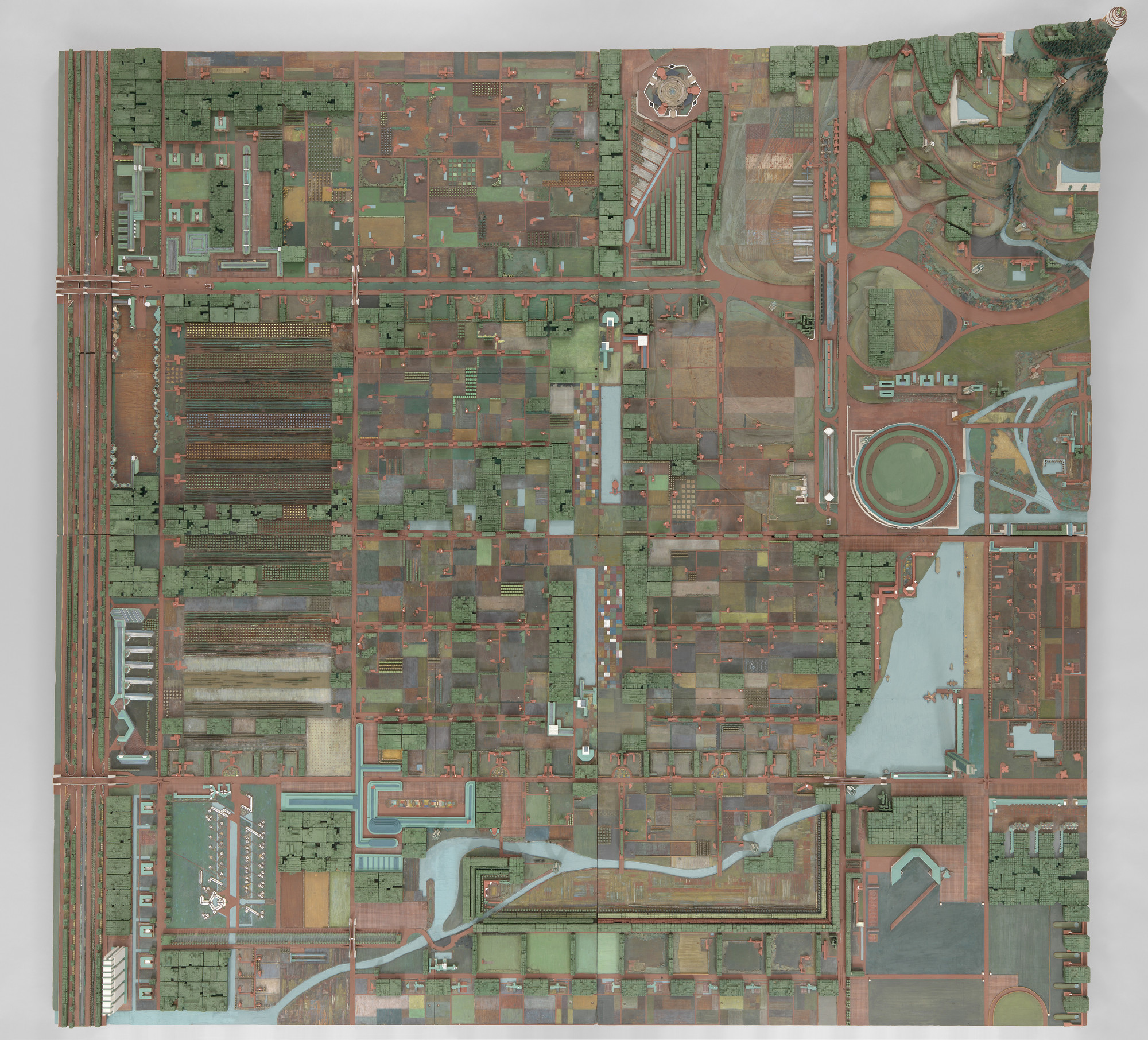
Curator, Juliet Kinchin: The architect, Frank Lloyd Wright is one of the giants of American modern architecture and design. This urban landscape was really the culmination of a project that Wright had been working on since the 1920s, known in its initial iteration as “Broadacre City.”
Wright was really fascinated by roads as a form of great architecture. So Broadacre City was imagined around this interconnected web of roads. The idea was that every family would own at least one car and live on and cultivate an acre of land.
All these homesteads would be distributed along a grid often combined with small-scale manufacturing and community centers. And motorized transport would transform agriculture and link consumers with fresh, locally-sourced food in roadside markets.
Each citizen of the future would have all the forms of production, distribution, of self-improvement, and enjoyment—all within a radius of some 150 miles of their homes.
It was seen as a model that would connect urban and rural communities across the United States. And I think the design really captures Frank Lloyd Wright’s sense of city as a greener more dispersed layout, which actually is in many ways keeping with the way we are trying to green our cities nowadays.