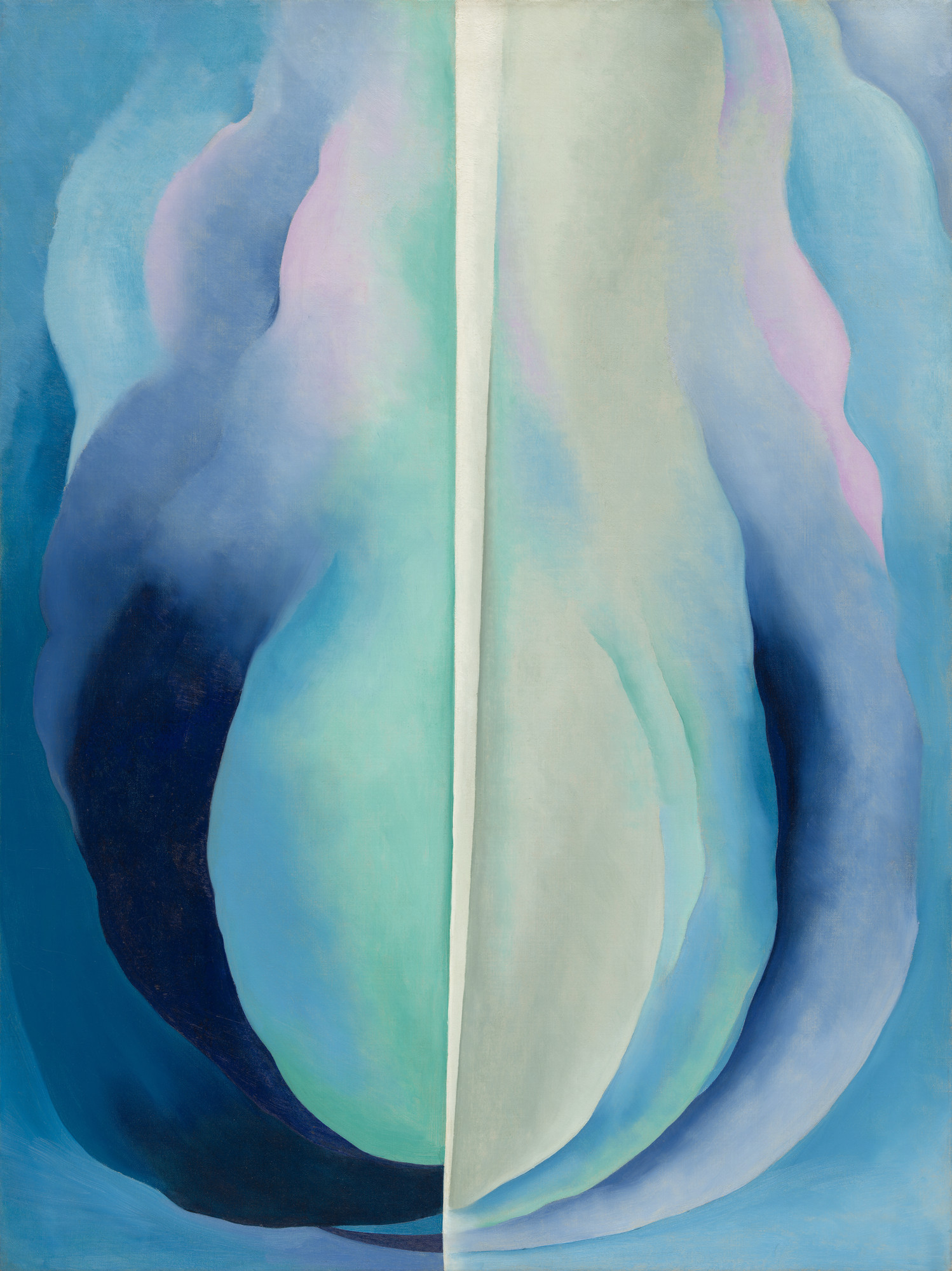
Conservator, Laura Neufeld: I think in this work, you see Georgia O’Keeffe experimenting with how to use color to create areas of dimensional modeling.
I’m Laura Neufeld. I’m Associate Paper Conservator at the Museum of Modern Art.
She’s laying different colors adjacent to each other and blending to create these rippling forms. And you see her creating very subtle transitions of tone and hue. She’s doing that with a brush, and she in fact had a brush that she used only to make transitions between colors.
Curator, Samantha Friedman: You get the sense there’s a kind of a depth that’s being implied, but of course the forms are very abstract. We don’t know exactly what it is we’re looking at.
I’m Samantha Friedman. I’m Associate Curator in the Department of Drawings and Prints at MoMA.
She said once, “A hill or tree cannot make a good painting just because it is a hill or a tree. It is lines and colors put together so that they say something.” So there’s this admission that, first and foremost, it’s lines and colors.
Her ability to distill a form to its essence, to reduce what she’s seeing in the world to a seemingly abstract visual language, is incredibly radical. And it’s something that male artists are being celebrated for in the ’50s and ’60s, but she wasn’t necessarily given the credit for looking at the world in the same way before they did.